
Live and Learn Farm

  • Home
    • About Us
    • Contact Us!
  • HomeSchool
    • All Inclusive
    • Apologia
    • Arts
    • Bible
    • Civics
    • Current Events
    • Curriculum
    • Elementary
    • Geography
    • History
    • Language Arts
    • Math
    • Middle School
    • Montessori
    • Other
    • Practical Life Skills
    • Science
    • Writing
  • Link Ups
    • Monday Middle & High School Link Up
  • Montessori
  • Teen Blogs
    • Gage – 13 Years Old
    • Chase – 14 Years Old
    • Blake – 10 Years Old
  • Shop
    • Cart
    • Checkout
    • My Account
  • Free!!!
  • Other Topics
    • Blogging
      • Facebook Series
    • Farmstead
      • Chickens
      • Cows
      • Permaculture Garden
    • Mom
You are here: Home / Archives for HomeSchool

Paths of Exploration Columbus Lesson 1 Part 2

June 18, 2013 By: Trish Corlew2 Comments

Columbus Lesson 1 Part 2


Disclosure

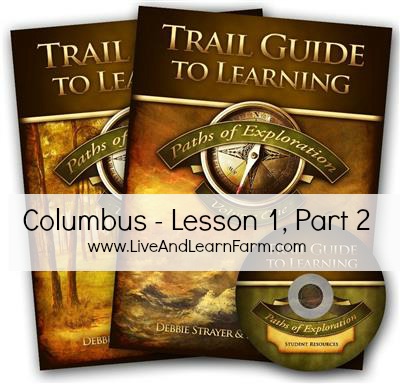
As you know we started Paths of Exploration by Trail Guide to Learning for our summer all-inclusive curriculum experiment.  As we have discussed many times, we homeschool with a very hands-on (Montessori-ish) approach to education, so we are using lots of  supplemental resources to augment this course.  Our plan is to do the entire Paths of Exploration as an intensive study over the summer and early fall!  This post is about Paths of Exploration Columbus Lesson 1 Part 2.  If you missed lesson 1, part 1, you can find it here. 

Section A:  Copywork/Dictation.  Focuses on “Language Skills and Thinking Skills”.  As in the Lesson 1, it is from the original poem, A Journey of Adventure, written by the late Debbie Strayer.  We are enjoying this work and we are finding more vocabulary words to add to our list.  We work on these vocabulary words between classes.  

Section B: Reader. Focuses on  “Language Skills” skills.  More reading from our required books. 

Section C: Read-Aloud and Narration. Focuses on “Language Skills and Thinking Skills”.  Today the boys had to retell specific passages of portions I read in their own words.  Again, There are two required reading books about Christopher Columbus. One is Meet Christopher Columbus and the other is Christopher Columbus.  
Meet Christopher Columbus
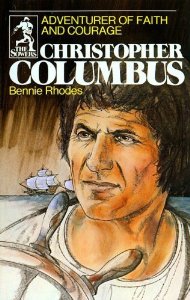
Christopher Columbus

Section D: Word Study. Focuses on “Spelling and Phonics”.  The words in Part 2 are the same vocabulary words in Part 1 and are too easy for even my nine year old. The boys “tested” (I asked them to spell each of these words individually and they all could) out of these and moved into more challenging words.  We did the new part of the section which provided the definition and you had to pick the word that best fit.  But, really it is still too easy.  Here are the words I added, if you would like to put some challenge in.  Unfortunately, they do not come from the reading… but we have used each of these words in our homeschool this past year.    

  1. frighten
  2. airtight
  3. birthright
  4. blight
  5. brighten
  6. delight
  7. enlighten
  8. insight
  9. knight
  10. nightfall
  11. plights
  12. weeknight

Another new part of Section D Word Study was to study the past tense of words. We were given words that we had to find the past tense from the read-aloud books from Section C.  This is still terribly basic, for middle schoolers especially.  Here is a hands-on work that could be used for a more advanced study of the tenses of verbs for the older students and a more well-rounded, hands-on lower elementary work can be found here.  We also did a study of the word “strange” and how it was used in the reading. The boys provided synonyms for the word according to how it was used in the different texts.  They all got it and used the word “strange” and its synonyms appropriately.  This section may end up being skipped altogether.  

Also in this section we discussed various cities and if they are situated on the Mediterranean Sea.  Again, I have no idea why this is in Section D when Section E is Geography.  But the boys absolutely love the geography aspect, so I’m not complaining!  

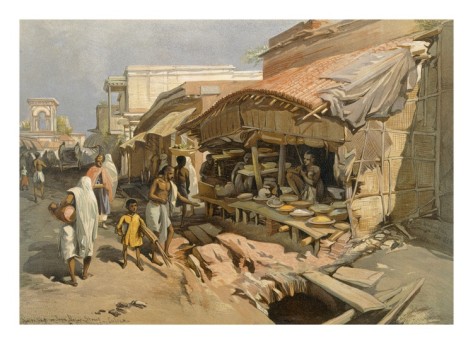
Section E:  Geography.  Focusing on “Thinking Skills”.  We studied what a bazaar is.  There are some discussion questions, but again, they are not terribly thought provoking.  We decided to take this section deeper.  We discussed what we might encounter at a middle eastern bazaar, the things you might see, hear, and smell.  We talked about the fact that they are usually open-air markets and what weather elements they might encounter and wondered aloud how they would protect the items they were selling… such as spices.  Speaking of spices, we wanted to experience what it might be like to walk into the spice tent at a bazaar.  Research shows the more senses you engage when learning new material, the more likely it will be remembered.  We made it a game, “Name that Spice Game“.  Be sure to check out that post.  It was fun (but there is a warning in that)!  

Native shop in a Calcutta Bazaar, 1867, William Simpson

Native shop in a Calcutta Bazaar, 1867, William Simpson

Section F:  Art. In this section we discussed how many of the items at a bazaar are handmade.  The text showed some rugs and discussed their patterns and where you might find them.  Then the boys were to draw their own.  This was fun.  We looked at many google images of African rugs!  They are so beautiful and vibrant!  

NA Rug 5
NA Rug 4
NA Rug 3
NA Rug 2
North African Rugs


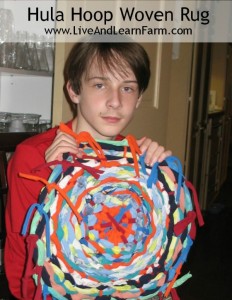
Hula Hoop Rug by ChaseBut, again, we like to take it deeper so we creating some of our woven products. We made a Hula Hoop Woven Rug!  You can find that post here.  We will be making an art hanging.  Be sure to check those posts out as well, I will come back and link them to this post as well.  

If you are looking for something a little less bulky, here is another weaving using a paper plate and yarn.  The blogger’s three year old daughter was able to do this one!  It is so precious!  


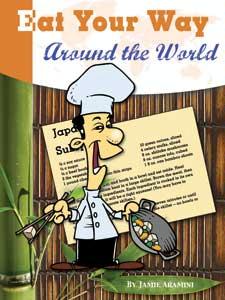
Eat Your Way around the WorldOne final piece of the Geography study that will always go over extremely well in my house is the cooking piece.  Remember Eat Your Way Around the World by Jamie Aramini is one of the required books.  We are to experiment with making dishes from Egypt and Morocco this week.  I will do another post or two about them!  

Section G:  Independent Reading.  As we discussed in Part 1, we modified this a bit so the boys will focus their reading on anything about Christopher Columbus for 30 minutes on Mondays, Wednesdays and Sundays. I wrote a post to share what our library resources are, you can find it here.  

Thoughts thus far… there seems to be a lot of inconsistency.  I expected the sections to stay the same throughout the Unit… they don’t. I’m not sure this is a big deal, but it is not what I would have expected.  Also, I don’t understand why there is a section called geography, but some geography work is listed in other sections. Again, it just makes it inconsistent and a bit confusing… but NOTHING that you can’t work around or overcome. Thus far I can say I’m pleased with this product.  We will continue to augment the lessons with a more hands-on approach, but I am pleased and am really liking the idea of an all-inclusive curriculum.  I’ll give you more detailed feedback as we get further into the curriculum… but I’ll sum it with “so far, so good”.  

I hope the additional hands-on lessons are a blessing to you and your children!  Please leave me a comment and let me know what you are thinking of this series… and if you decide to purchase it and use it… let me know!  I’ll be creating a blog roll for all of us with posts about Paths of Exploration sometime this summer!  

Until next time…


If you like this post, please share it!

  • Share on Facebook (Opens in new window) Facebook
  • Share on Pinterest (Opens in new window) Pinterest
  • Share on X (Opens in new window) X
  • Print (Opens in new window) Print
  • More
  • Email a link to a friend (Opens in new window) Email
  • Share on Reddit (Opens in new window) Reddit
  • Share on LinkedIn (Opens in new window) LinkedIn
  • Share on Tumblr (Opens in new window) Tumblr

Like this:

Like Loading…

Orienteering Scavenger Hunts Using a Map and Compass

June 17, 2013 By: Trish Corlew17 Comments

Orienteering Scavenger Hunts

Disclosure

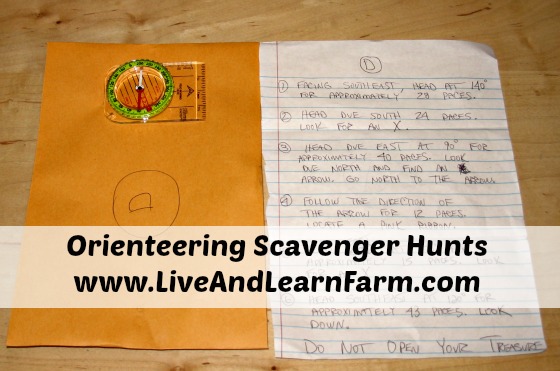
This past weekend was Father’s Day and my middle son, Gage’s birthday.  What did we do?  We all learned how to use a compass! How? By Orienteering Scavenger Hunts using a map and compass. As you probably have already read, in our Paths of Exploration Columbus Unit: Lesson 1, Part 1 study, we learned about the compass. We did all the worksheets for the compass in our POE student notebook, we printed out a great compass work from Montessori Print Shop. We even made  our own compass… but we didn’t learn how to use one, especially when using bearings and degrees.  That’s where orienteering comes into play. On Father’s Day, my hubby David was busy setting up a scavenger hunt for the boys and their best friend, Austin!  Each received their own packet, which contained, a compass and directions to find a treasure at the end of their individual courses. 

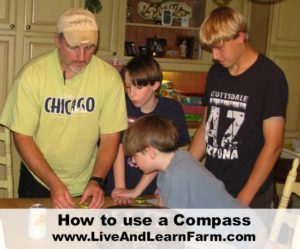
How to use a Compass LessonWe started inside with a quick lesson on how to use a compass.  I found some great instructions here and here.  But, that inside lesson was not as effective as we thought it would be.    

Once outside, they each opened their packets and read through their direction. After studying their packet a minute or two, they all decided they needed another lesson that was practical instead of theoretical … good thing that is our educational philosophy. In our homeschool and on our farm, it’s all about hands-on learning, we learn it while doing it!

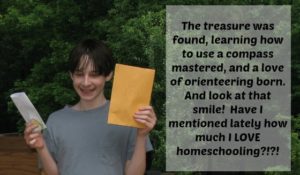
Chase was the first to finish!  They all loved this project and each found their treasure Finished Firstsuccessfully. More importantly, they loved learning how to use a compass and hunting for an object … see the smile on Chase’s face! For those curious, here is the compass we got for each of the boys.  They were not expensive and Silva is highly regarded in the orienteering world.  They all worked well and were easy to use and read.  

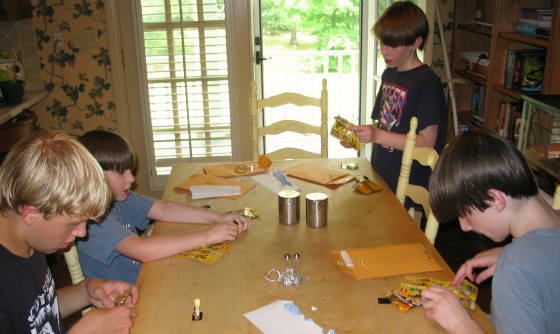
This was their treasure they found at the end of their scavenger hunt.  You don’t know what mini-figure you are getting and could find a Mr. Gold in their packet. (No Mr. Golds were in these though.)

Orienteering Treasures Found


Did you know Orienteering is considered a competitive sport? Here is a link to one of the Orienteering sites to teach you more about this fun sport. There are many orienteering teams around the US too, but unfortunately, none in TN or MS.  Here is a link to see if they have one in your area.  If you decide to do this with your children, please post a link to your post below!  The boys LOVED the scavenger hunt and my hubby loved setting up the course!  We will be doing this again and soon!  Here are a few more pictures of the boys in action:  

Geography – Orienteering

One final note, we learned today that one of the authors of Paths of Exploration, Debbie Strayer passed away over the weekend.  Our thoughts and prayers are with her family and the good folks at Geography Matters!!! 

Until Next Time…


If you like this post, please share it!

  • Share on Facebook (Opens in new window) Facebook
  • Share on Pinterest (Opens in new window) Pinterest
  • Share on X (Opens in new window) X
  • Print (Opens in new window) Print
  • More
  • Email a link to a friend (Opens in new window) Email
  • Share on Reddit (Opens in new window) Reddit
  • Share on LinkedIn (Opens in new window) LinkedIn
  • Share on Tumblr (Opens in new window) Tumblr

Like this:

Like Loading…

Name that Spice Game

June 17, 2013 By: Trish Corlew4 Comments

Name that Spice

Disclosure

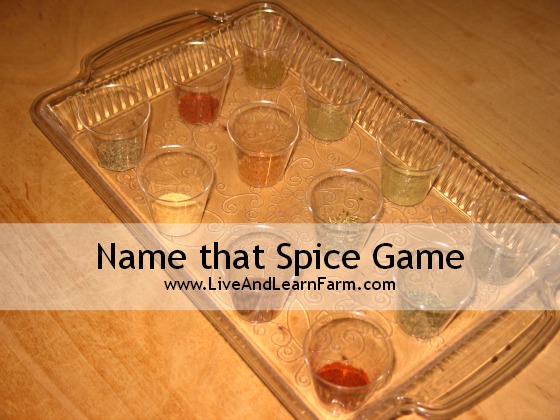
Can you imagine how fabulous (and pungent) it would be to walk into a spice tent?  As you know, we are hands-on (Montessori-ish) Homeschoolers, so we decided to create a “Name that Spice Game” to experience that blend of spices smell on a small scale. In Lesson 1, Part 2 of our Paths of Exploration Columbus Unit, we studied about ancient open-air bazaars, such as the ones you might find in Middle Eastern countries today.  Explorers liked to bring home spices from bazaars to sell in their own countries.  

This game is a spin-off of a Montessori work, Scent Jars. If you have younger students that have not used this activity, I highly recommend using it with this lesson first.  Remember, all Montessori works are teaching a life-principle or concept that is much deeper than the obvious work itself.  For example, for the smelling jars, your child is not just being taught how to be able to identify a specific spice smell, the lesson’s goal is to help your child become aware of scents in their environment.  Another reason younger students should do the traditional work can be found in the WARNING at the bottom of this article.  

Over the last several years, we have studied why our olfactory system (our sense of smell) is important to us in our various Apologia Textbooks: Human Anatomy and Physiology, an elementary study and human anatomy is the entire second half of General Science, the first middle school science book.  The sense of smell is a way for us to gather messages about the environment around us. So, literally, with each breath we take, we are sampling our environment for smells that would indicate various dangers, food, or other individuals, etc.  

Since my boys are older and have already had the luxury of using the Montessori primary curriculum (including the smelling jars), we made an extension for our purposes.  Here is a list of spices you can use, the spices that are in bold type are the ones we used.    

  • Allspice
  • Basil
  • Bay Leaf
  • Black Pepper
  • Cayenne pepper
  • Celery Seed
  • Chili Powder
  • Chives
  • Cilantro
  • Cinnamon
  • Clove
  • Garlic
  • Ginger
  • Lavender
  • Mustard Seed
  • Nutmeg
  • Oregano
  • Paprika
  • Parsley
  • Peppermint
  • Poppy seed
  • Rosemary
  • Sage
  • Spearmint
  • Thyme


Materials:

12 Spices

Party Cups (Read the Warning at the bottom of the post)

Tray

Notebook paper

Pencil

Stickie Notes 


Directions:

1.  Choose 12 different spices.  

2.  On the bottom of each cup, prior to pouring in the spice, number the cups 1-12, with a sharpie.  

3.  Pour a small amount of spice into one cup.  Place a stickie note on the spice jar with the number that corresponds to number on the bottom of the cup that contains that spice.  

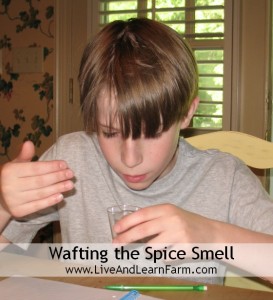
4.  Share one cup at a time and request that your children use their hand to wave the smell toward their nose.  It is called Spice Game Waftingwafting and here is a demonstration.  You will see why you should not put your nose over the cup and sniff when you read the warning at the bottom of this article.  

5.  Have your children number their paper 1-12.  As they finish exploring each spice, ask them to write the name of the spice they think each smell is.  I did not blindfold my boys, but this would narrow the senses being tested down to just their sense of smell (and, in the process, protect those eyes)!  Since I did not blindfold, my boys could see the color, texture, and features of each spice, which did make it a little easier)!

6.  Once your children have explored all 12 spice scents, reveal what each spice is, starting with #1. 

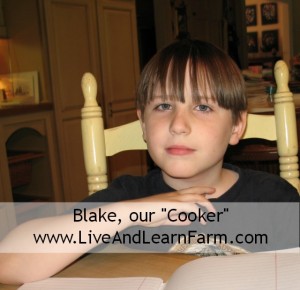
Spice Game Blake I was a little bit surprised with the results.  Blake loves to cook and is in the kitchen with me cooking most meals.  So, I expected him to do extremely well (and he did, 10 out of 12 he got right).  But Gage came in a close second and he rarely cooks. However, Gage has always seemed to have heightened senses, so maybe this was just further confirmation of that theory.  Chase was a distant third!  He needs more time in the kitchen cooking, apparently!  

Spice Game Warning

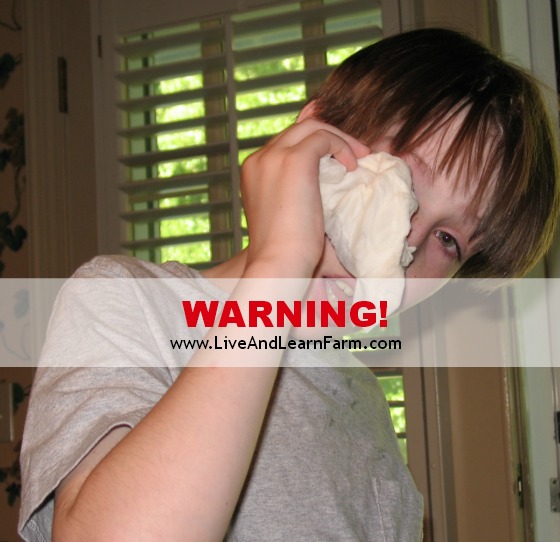
WARNING!!  When dealing with anything you are smelling, there is always a chance of getting too strong a whiff or getting it in your eyes. Therefore, I’ve always been taught and taught my boys that to smell an unknown item, you should do so by waving their hand over the item to draw the scent to you (wafting). Well, even with this lesson firmly established and us using this practice throughout this project, Gage, my 12 year old son, on the next to the last spice, got that spice in his eyes, not once but TWICE.  Gage decided he couldn’t smell the spice with just the light scent his hand was able to direct toward his face, so he put his nose over the cup of spice.  Well, he breathed into the cup accidentally and the Ground Clove flew right into his eyes. I’m still thanking our Father in Heaven it was only Clove… it could have been MUCH worse. So, if you have young children I recommend NOT using open cups with spices.  

See why we named the blog (and our farm) “Live and Learn” Farm? We are always learning…. sometimes, the hard way!  I’m not sure who learned this lesson more, me or Gage!  

Until Next time…


If you like this post, please share it!

  • Share on Facebook (Opens in new window) Facebook
  • Share on Pinterest (Opens in new window) Pinterest
  • Share on X (Opens in new window) X
  • Print (Opens in new window) Print
  • More
  • Email a link to a friend (Opens in new window) Email
  • Share on Reddit (Opens in new window) Reddit
  • Share on LinkedIn (Opens in new window) LinkedIn
  • Share on Tumblr (Opens in new window) Tumblr

Like this:

Like Loading…

11 Must-Have Math Story Books

June 14, 2013 By: Trish Corlew6 Comments

Disclosure

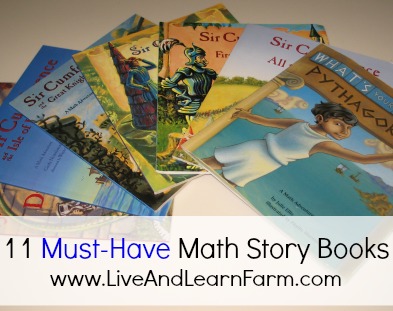
As a homeschooling mom of upper elementary and middle school children, I sometimes struggle to find reading resources that both my 11 Must Have Math Story Booksboys and I love, especially math.  The ones listed below are ones that we all agree are fabulous!  I can not tell you how many times we refer to these stories when remembering equations or concepts! Look at their ratings… we are not the only ones that love them. We read them in lower elementary, but we regularly review them now in upper elementary and middle school.  The stories are fun and silly and most importantly, MEMORABLE, which is the goal, right?  So let’s get to the list of Must-Have Elementary Math Stories!  When you click the pictures below, it will take you directly to Amazon.  


Pythagoras


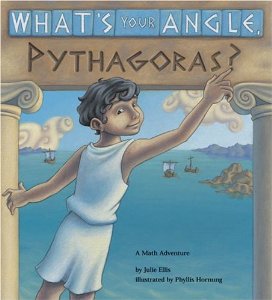
What’s Your Angle, Pythagoras.  Grades 3-5 (although I would say upper elementary 4-6).  A fictionalized look at Pythagoras as he discovers his famous theorem. He is depicted as a curious boy who travels with his father from Samos to Alexandria, where he meets a builder named Neferheperhersekeper, who introduces him to the right angle. He begins to experiment, observing and noting the fixed and unvarying mathematical nature of triangles–right triangles, to be precise. The cartoon illustrations capture the dress, homes, and sailing ships in a warm and clear palette. Ellis includes delightful puns for those who are keen on wordplay. Sticklers be warned: there is lots of dialogue, but in the context of the story, it works well and helps to explain the math. This clear and interesting explanation of the theorem is a wonderful read.


Pythagoras and the Ratios

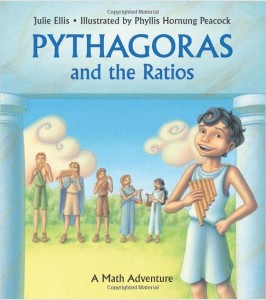
Pythagoras and the Ratios by Julie Ellis carries young mathematicians and musicians back to Ancient Greece where an ever-curious Pythagoras enjoys solving problems so much that he often forgets to finish his chores. Young Pythagoras helps his cousin Octavius tune his new pipes by comparing them to his own and realizing that because they are twice as wide, they also need to be twice as long. Using the same ratios, he ties rocks of varying weight to the lyres of Reyna and Amara so that all of the cousins can play their instruments together for the first time in history.


Sir Cumference and the Dragon of Pi

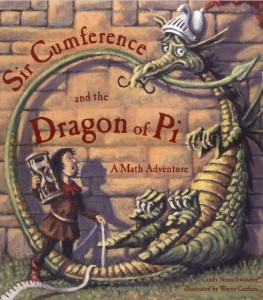
Sir Cumference and the Dragon of Pi.  When Sir Cumference turns into a dragon, Lady Di of Ameter helps him hide, while Radius searches for the cure–the magic number that is the same for all circles.


Sir Cumference and the First Round Table

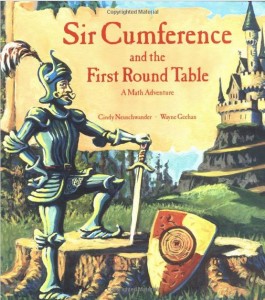
Sir Cumference and the First Round Table.  King Arthur has a Problem! When his knights get together, they sit at such a long table that everyone has to shout to be heard. Can Sir Cumference and Lady Di of Ameter ”measure up” to the challenge of building a better table? Explore the castle, watch a tournament, and ride along with Sir Cumference as he searches for the shape of the future. Noisy knights, a clever carpenter, and a juggling jester all add to the fun.


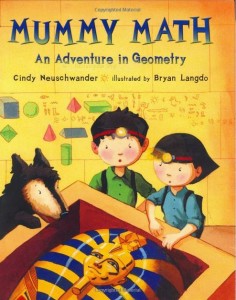
Mummy Math

Mummy Math.   The Zills family is summoned to Egypt to help find the hidden burial chamber of an ancient pharaoh. But when Matt and Bibi get trapped in the pharaoh’s pyramid, they stumble upon an even bigger mystery. With only each other, their dog Riley, and the geometric hieroglyphics on the walls to help them, the twins must use their math skills to locate the burial chamber—and the way out. Luckily, Matt and Bibi know their stuff when it comes to geometric solids, and so will the readers of this adventure in math!


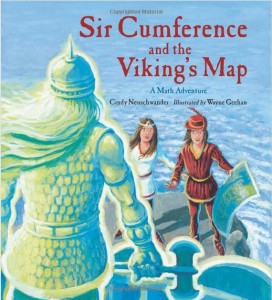
Sir Cumference and the Vikings Map

Sir Cumference and the Viking’s Map.  Xaxon Yellowbearyd was the fiercest Viking warrior of his time. Now a map to his hidden treasure lies in Radius’s and Per’s hands. Together the cousins must decode the strange numbered grid on the map-and figure out the secret of the Viking’s X and Y axes. As bungling bandits pursue them, Radius and Per use coordinate geometry in their quest for “treasure of the greatest measure”.


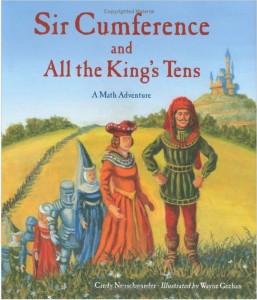
Sir Cumference and all the Kings Tens

Sir Cumference and All the King’s Tens.  Sir Cumference and Lady Di planned a surprise birthday party for King Arthur, but they didnt expect so many guests to show up. How many lunches will they need? And with more guests arriving by the minute, what about dinner? Sir Cumference and Lady Di have to figure out a quick way to count the guests to bring order to the party. Sir Cumference and his friends have been entertaining young and old alike for years as they introduce important math concepts with clarity and humor.


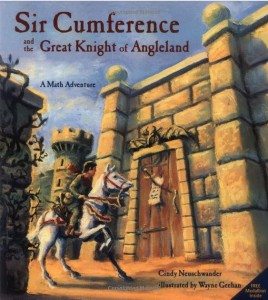
Sir Cumference and the Great Knight of Angleland

 Sir Cumference and the Great Knight of Angleland.  On a quest to earn his knighthood, Radius uses different geometry concepts to find and rescue a missing king.


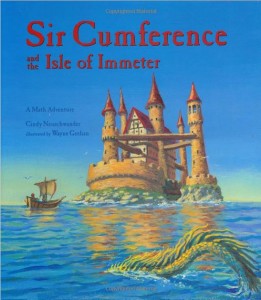
Sir Cumference and the Isle of Immeter

Sir Cumference and the Isle of Immeter. In an adventurous title that teaches math skills, such as finding the area and perimeter of a rectangle and a circle, young Per must figure out how to unlock the secrets of the mysterious island of Immeter.


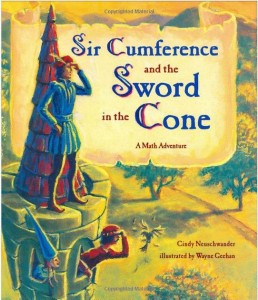
Sir Cumference and the Sword in the Cone

King Arthur and the Sword in the Cone.  King Arthur has issued a challenge. The first knight to find the sword, Edgecalibur, will be the next king. Sir Cumference, Lady Di of Ameter, and Radius help their friend, Vertex, find the sword. 


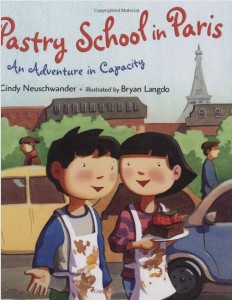
Pastry School in Paris An Adventure in Capacity

Pastry School in Paris.  The Zills family is off to Paris to see the sights and take a class at the International Pastry Academy! In class, Matt and Bibi have to measure liquids to make lollipops. It’s hard work, but knowing about different liquid measurements comes in handy when the Inspector General pays a visit while everyone else is out.  The twins want to help. Will their knack for baking the best-ever brownies and their knowledge of capacity be enough to save the day?


What are your favorites?  Please leave a comment below so we can check them out too!  Until next time… 


If you like this post, please share it!

  • Share on Facebook (Opens in new window) Facebook
  • Share on Pinterest (Opens in new window) Pinterest
  • Share on X (Opens in new window) X
  • Print (Opens in new window) Print
  • More
  • Email a link to a friend (Opens in new window) Email
  • Share on Reddit (Opens in new window) Reddit
  • Share on LinkedIn (Opens in new window) LinkedIn
  • Share on Tumblr (Opens in new window) Tumblr

Like this:

Like Loading…

Middle School Christopher Columbus Resources

June 12, 2013 By: Trish Corlew6 Comments

Christopher_Columbus Resources


Disclosure

In my article on Paths of Exploration Columbus Unit, I mentioned our library of resources and decided to list for you what we are using for our upper elementary and middle school Christopher Columbus resources.  These are not all the great books out there, but the ones we need that we don’t have we either purchase on Kindle or we borrow from the public library.  I pray these resources will be a blessing for your homeschoolers! 

First I thought I would share the required reading books (and materials) for the Trail Guide to Learning Paths of Exploration Columbus Unit curriculum.  

Columbus Study

Required Reading / Materials

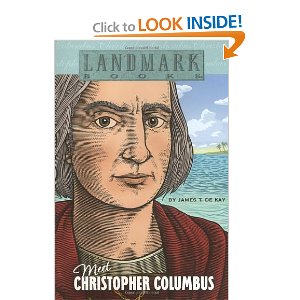
Meet Christopher Columbus by James T. de Kay 

Christopher Columbus by Bennie Rhodes

Intermediate World Atlas

Eat Your Way Around the World

A Globe

Crayons or Colored Pencils

Paste

A Thesaurus

A Dictionary

Birthday Pictures

Yellow Highlighter or Crayon

Index Cards or Paper

Graph Paper

Magazines, Newspapers, etc.

Large World Outline Map

Carry On, Mr. Bowditch (Middle School Supplement Required Reading)

Our Christopher Columbus Resources 

Christopher Columbus Coloring Book (For drawing not coloring)

Columbus Day by Vicki Liestman Lower Elementary Reading Level

Scholastic Atlas of Exploration by Dinah Starkey Upper Elementary Reading Level

The Usborne Book of Explorers From Columbus to Armstrong Upper Elementary Reading Level

The Value of Curiosity:  The Story of Christopher Columbus a ValueTale by Spencer Johnson, M.D.  Upper Elementary Reading Level

Kids Discover Columbus October 1992 Issue Lower and Upper Elementary 

The Life and Times of Columbus by Curtis International / Portraits of Greatness Series Middle School – High School

Columbus For Gold, God, and Glory by John Dyson / Peter Christopher Middle School – High School

The Conquest of Paradise:  Christopher Columbus and the Columbian Legacy High School

A New History of the United States by William Miller and George Braziller High School

The Oxford History of the American People by Samuel Eliot Morison High School

And just to be sure we study all the recent research on Christopher Columbus, there are quite a few scholars that are now hypothesizing that Christopher Columbus was Jewish.  You can find articles about this in CNN, Huffington Post, as well as Christopher Columbus’ Jewish Roots by Jane Francis Amler.

If you know of other books or resources that you would add to the list, please comment below with the title and author!  

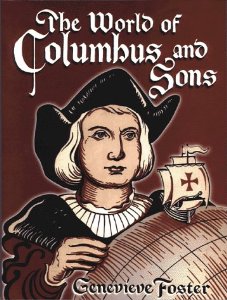
The World of ColumbusUPDATE 7/12:  I have since added a fabulous book that has not been added to our library list yet. The World of Columbus and Sons by Genevieve Foster. This author has written many books (I purchased several used in a lot on ebay). I stumbled upon these when reading somebody’s discussion of the Beautiful Feet History curriculum. These readers are a core part of BF History. We just love them. The summary of the book from Amazon reads:

This is the story of a wonderful, changing, reawakening world the world of the Renaissance and Reformation. Measured by the lifetime of Columbus and his sons, this book spans the years from 1451-1539. With Columbus as the central figure of this narrative, readers will also learn the fascinating stories of Prince Henry the Navigator, Ivan III of Russia, Gutenberg, Queen Isabella, Leonardo da Vinci, Mohammed II, the African ruler Nomi Mansa, Martin Luther, Erasmus, Albrecht Dürer, Copernicus, Michaelangelo and many others. Told in Foster’s engaging and winsome style enhanced by her helpful chronologies and timelines, readers will learn of the religious, cultural and scientific changes that ushered in a new frontier of exploration and discovery.

I have started calling books like this Historiction. Historical but within a fictional story. Think about all the great Henty Books that are exactly this same formula. My boys seem to love them so that is another book that is part of their 30 minute reading options.  

Until next time……

If you like this post, please share it!

  • Share on Facebook (Opens in new window) Facebook
  • Share on Pinterest (Opens in new window) Pinterest
  • Share on X (Opens in new window) X
  • Print (Opens in new window) Print
  • More
  • Email a link to a friend (Opens in new window) Email
  • Share on Reddit (Opens in new window) Reddit
  • Share on LinkedIn (Opens in new window) LinkedIn
  • Share on Tumblr (Opens in new window) Tumblr

Like this:

Like Loading…

How to Make a Compass

June 11, 2013 By: Trish Corlew8 Comments

How to Make a Compass

Disclosure

As part of our Paths of Exploration curriculum for the Christopher Columbus unit, we decided to research how to make a compass. We found an easy 20 minute project and decided to make it!!  The boys completed a Scientific Speculation Sheet from our Apologia Curriculum and added this to their Paths of Exploration Student Notebook.  Below are the details for how to make a compass! 

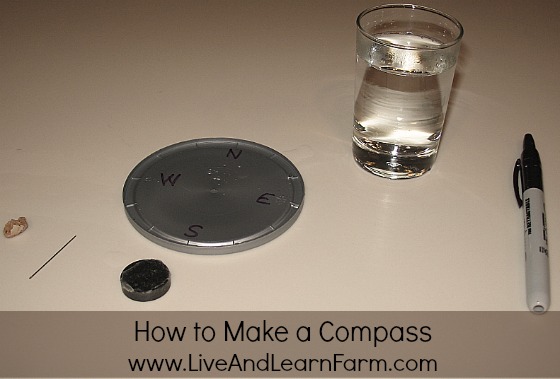
Materials List:

  • A Small Piece of Cork
  • A Sharpie
  • A Plastic Lid
  • A Needle
  • A Magnet

Directions:

1.    Write the initial for the cardinal directions on the inside of the plastic lid (see picture at the top of the post).  

2.    Place the lid on the table with the “N” pointing North.  

3.    Once the ink dries, fill the lid with water.  
Magnetize Needle

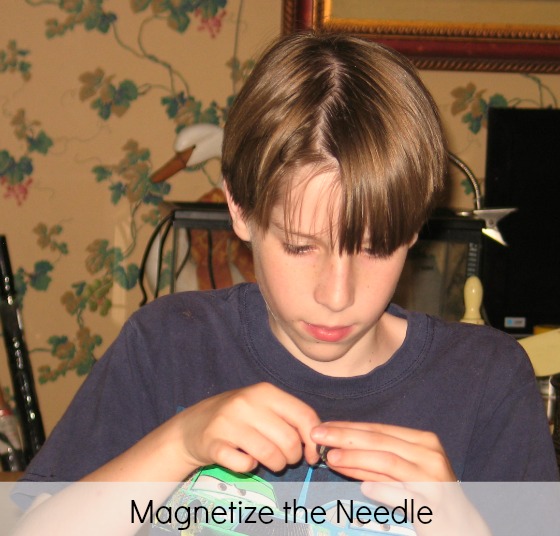
4.    Take the magnet and brush the needle over it moving your hand in the same direction several times (do not go back and forth, just one direction).

Compass Needle Cork

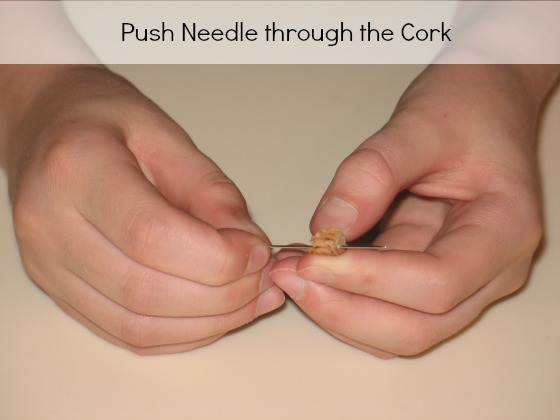
5.    Push the needle through the small piece of cork.  Be sure the cork will be able to float freely in the water in the plastic lid before you push the needle through.  

6.    Place the needle and cork in the water.  One end of the needle should be pointing North.  

7.    Turn the lid now to see what happens.  Document the results.

So What Is happening?  

Magnetic fields contain a force that is created by moving electrical charges. The Earth produces a magnetic field  and this field is quite weak. It is sufficiently strong enough to align magnetized objects, such as the needle in our compass. By floating the needle on the cork, you allowed it to rotate freely. So the needle became lined up with Earth’s magnetic field and points toward the north or south pole of the planet.  

For a very detailed middle / high school level explanation of what is happening with the magnetism, see this GREAT article on Magnetism by Dr. Lensyl Urbano (PhD Geology and Geophysics) from Montessori Muddle.  I’ve been following this blog for a while and it is one of my favorites for upper level science with a hands-on perspective.  

As we work through the Paths of Exploration curriculum this summer, there will be lots more hands-on posts, so stay tuned!  

Until next time…. 


If you like this post, please share it!

  • Share on Facebook (Opens in new window) Facebook
  • Share on Pinterest (Opens in new window) Pinterest
  • Share on X (Opens in new window) X
  • Print (Opens in new window) Print
  • More
  • Email a link to a friend (Opens in new window) Email
  • Share on Reddit (Opens in new window) Reddit
  • Share on LinkedIn (Opens in new window) LinkedIn
  • Share on Tumblr (Opens in new window) Tumblr

Like this:

Like Loading…

Paths of Exploration Columbus Lesson 1 Part 1

June 11, 2013 By: Trish Corlew7 Comments

Columbus Study


Disclosure

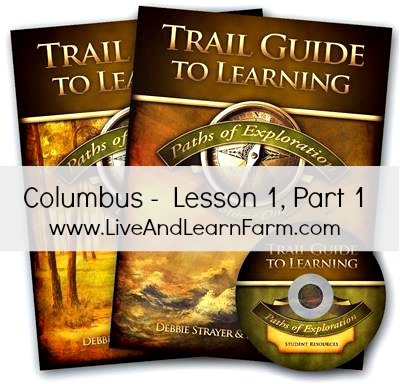
Launch Day!  We started Paths of Exploration by Trail Guide to Learning today!  As most of you know, we homeschool with a very hands-on (Montessori-ish) approach to education, so we are using lots of  supplemental resources to augment this course.  We are doing the entire Paths of Exploration as an intensive study over the summer, so there will be lots of territory covered in my posts!   As I post these articles, I will also be giving reviews of their product in a real-world, running review of this curriculum. This article is about Paths of Exploration Columbus Lesson 1 Part 1.


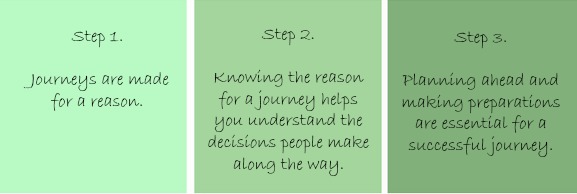
Steps for thinking


We decided to do the upper elementary section for all of Columbus first and then circle back and do the Middle School supplement curriculum after we finish Columbus Upper Elementary curriculum.  That way, all of the boys have the foundation that the Upper Elementary curriculum lays first before we jump into a more extensive Columbus Middle School study.  Besides, we are just figuring out the style of this curriculum and I’m already seeing areas that need to be refined and cleaned up! But we are going to do Columbus Unit pretty much as it is presented in both the Upper Elementary and the Middle School texts with a few minor modifications. After we have completed both texts, we may decide to modify our approach.   

Section A is Copywork/Dictation with “Language Skills” being the area mentioned as the target for this section.  I really thought I would skip this section before we started, but I decided to teach ColumbusHandwriting without Tears pretty much as it is presented and I am glad I did (at least for this section).  It is good for them to hear poetry and to try to transcribe it from my dictation. Any missed words become part of their vocabulary words for that week. It was fun and it is a great way for me to keep their handwriting skills up. All of the boys are excellent at writing (Thank you Handwriting without Tears!)… and yes, they learned how to write cursive!!  The dictation was from an original poem by Debbie Strayer (one of the authors).  

Section B is Reader with “Language Skills, Thinking Skills, and History” listed as the areas targeted by this work area. This is where everything was terribly mixed up!  There are two required reading books about Christopher Columbus. One is Meet Christopher Columbus Meet Christopher Columbusand the other is Christopher Columbus.  Since the names are so close, it would have been helpful if they explained which one to read from (maybe giving the author each time).  
Section C is Read-Aloud and Discussion and the targeted areas for this section are “Language Skills, Thinking Skills and Writing”.  I have no idea why there are two sections both with a focus on reading aloud.  This is why it was confusing.  In Section B it says “read one or two pages aloud” but in Section C it states “listen as your teacher reads pages 1-6 aloud”.  The boys JUST read pages 1-2 aloud and now I’m reading these same pages again? I thought maybe I had the boys read the wrong book aloud, but no, it’s the same book Christopher Columbus.  So, this was confusing.  We have two hard copies of both these books for us to use but I also purchased a Kindle version of Meet Christopher Columbus and the boys all downloaded it onto their Kindles for Christopher Columbustheir read aloud sections.  I had all three boys take turns reading paragraphs.  The Bennie Rhodes book was not available as a Kindle download.  Anyway, they really enjoyed being able to read it from their own Kindles (and even figured out how to have their kindles read to them… LOL)!  The discussion question was terribly basic for this age group (What do you think Christopher Columbus’ dream was when he was a young boy?”.  Both books we read aloud provided the answer.  If you were paying half a second of attention, you would have this question answered.  Maybe that was the point for the first Lesson, but the boys could have handled a much more thought-provoking question!  

Section D is Word Study. The areas focused on with this section are “Spelling, Phonics and Vocabulary”. For this one the authors discuss “long I” words from the original poem that were part of the copy/dictation work from Section A.  This was very basic also for upper elementary students.  We did it but we will augment the next lesson to add more challenging words!  There was also a discussion here about the prefix “un” and how it was used in the reading from Sections B and C.  They provide an area for the students to list 6 words that start with “un” and define them.  This was pretty fun for them, but still very basic. 

un equals not

globe

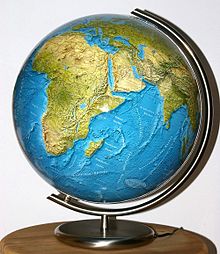
Also as part of Section D we located cities in Italy on the globe. We loved this part and the boys did great… just one thing, the next section (section E) is Geography.  Why did they put this under Section D, Word Study?  I have to assume it was a mistake.  They also had to identify port cities in the US after defining what a “port” is.  With the help of the globe, they listed out several from both coasts.  That was a fun activity as well.  

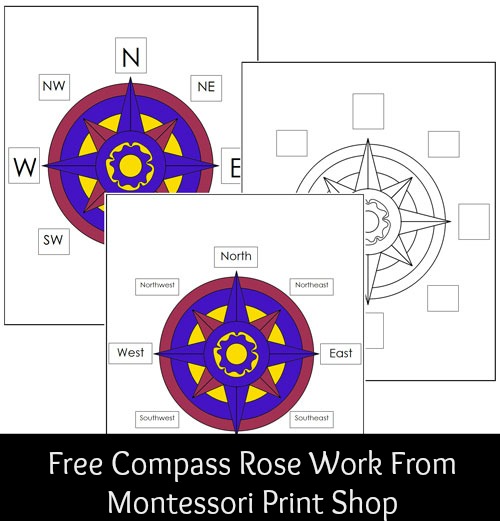
Like I just mentioned, Section E is Geography with the area targeted being listed as “Science”.  Here we are learning about a compass.  We did the worksheets for the CompassRose-MPScompass but we also printed out this great compass work from Montessori Print Shop. Since we love hands-on learning, we decided to create our own compass. Here is that post.    

Section F is Writing with “Thinking Skills” being listed as the area being targeted. The boys were to list the details of Columbus’ birthday as described in the text.  Then list the details from a typical birthday for them.  In the student notebook is a Venn diagram where they would list the individual traits for each and the common traits.  Great exercise!  

Finally, Section G is Independent Reading.  At the beginning of the provided student notebook is a reading list. The independent reading section is meant to be just thirty minutes of fun reading. However, this is exactly what they do every night already, so we have modified this a little bit so they can read anything about Christopher Columbus for thirty minutes on Wednesdays and Sundays. We have quite a few Columbus books in our library from coloring books and picture books to exhaustive studies … so they should not run out of material to read for a while. I wrote a post to share our library resources, you can find it here.  One other modification I have made is I added in an art component.  All of my boys took Drawing this past year as an elective, so on Tuesdays and Thursdays, they are going to spend thirty minutes each day drawing something that is applicable to the subject we are studying.  They do not have to complete their drawings the same day or even the same week. I can’t wait to see what they come up with!  

We are year-round homeschoolers, however most of the curriculum the boys were working on during the year they have completed.  So this curriculum is a great way to keep many of the skills the boys have acquired over the year fresh and to dive into a new subject.  In addition to this curriculum, the boys are keeping their math going all year.  So their workload is dramatically reduced during the summer.  I know some may be wondering why we do this.  Well, we quickly realized after that first summer off from homeschooling that it was quite hard to get back into the routine.  We decided (with the boys) that we would have a dramatically reduced schedule, but would keep going during the summer months.  For me, this curriculum is an experiment.  I have been toying with the idea of using an all-inclusive curriculum for a couple of years;  one where all the subjects (with the exception of Science and Math) are covered and are integrated.  This curriculum may or may not be the right one for an all-inclusive, but this was a great one to test the concept with.  I’ll give you more feedback on that as we work through this curriculum.  I hope these posts will be a blessing to you and your family!  If so, leave me a note!  

Until next time…. 

We are connecting this week with the Ultimate Homeschool Link-up.  Be sure to visit them and the other bloggers linked there, they all have GREAT posts!  I especially love the Firefly one!

 The Homeschool Village

If you like this post, please share it!

  • Share on Facebook (Opens in new window) Facebook
  • Share on Pinterest (Opens in new window) Pinterest
  • Share on X (Opens in new window) X
  • Print (Opens in new window) Print
  • More
  • Email a link to a friend (Opens in new window) Email
  • Share on Reddit (Opens in new window) Reddit
  • Share on LinkedIn (Opens in new window) LinkedIn
  • Share on Tumblr (Opens in new window) Tumblr

Like this:

Like Loading…

Philosophy Adventure Giveaway and Launch Party

May 31, 2013 By: Trish Corlew4 Comments

philosophy adventure 4


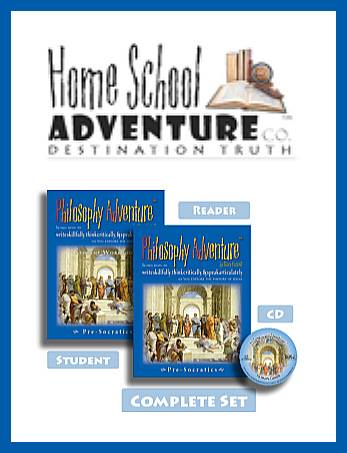
I am excited to tell you about a new Homeschool Curriculum called Philosophy Adventure by Stacy Farrell at Homeschool Adventure Co. I was asked to be a part of their launch team and I am thrilled to have found this curriculum. So, welcome to our Philosophy Adventure Giveaway and Launch Party! I was given a digital copy of this curriculum, in exchange for my honest opinion and assistance in finding those pesky little typos that sneak through the editing process (as all of us bloggers know oh too well).  I do not and will not receive any compensation for my review other than the curriculum mentioned above!  Be sure to read to the bottom of the post where you can register to win a free digital copy of the complete curriculum!  

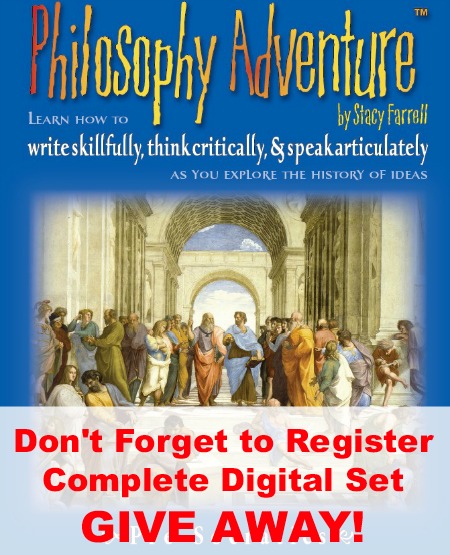
So, Let me introduce you to Philosophy Adventure. It was written by Stacy Farrell and is designed for students in the 6th – 12th grades.  We will be using this curriculum next year with our 8th, 7th and 4th graders.  It will be a little stretch for my youngest, but we will be able to modify it to fit his skill set.  Philosophy Adventure™ helps our children cultivate and defend a biblical worldview by teaching them how to write skillfully, think critically, and speak articulately as they explore the history of philosophy and the impact of ideas.

I know “Philosophy Adventure” sounds like it is all about philosophy, which is overwhelmingly not Biblical at all, but I can assure you it’s much more than just a curriculum about philosophers!  The study examines the pre-Socratic philosophers, what they taught, thought, what and who influenced their thinking and who they interacted with.  But most importantly, it introduces their teachings from the perspective of how does it fit with a biblical worldview.  So, it asks the question and our students answer…  how does each of these philosophers’ view match or conflict with a Biblical worldview.  Although this material can be used for our children to work independently, I think it is far more valuable as a tool to provoke thoughtful and deep discussion for the entire family!  

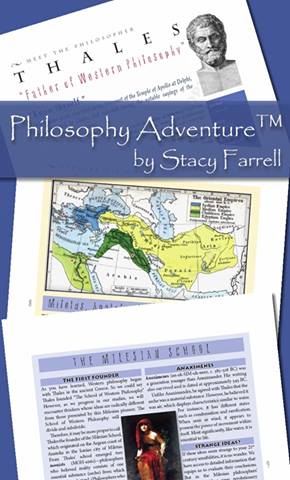
Philosophy Adventure 2

As most of your know, we have a Montessori slant to our homeschool environment.  One of the foundational principles of a Montessori education is that of being life long learners.  Ironically, Stacy mentions in the introduction:

We consider ourselves students rather than scholars.  Life-long learners.

AND, not only is Stacy’s educational philosophy in-line with our Montessori leanings, but there are also Memory Cards that we fully intend to use to create a board game; a timeline that shows not only the philosophers, but also is color coded to show the Rulers, Prophets, Biblical Heroes, Scientists, Literary Works and Major Events of their time; Map and geography work; a Write, Think and Speak Journal; and more!  It meshes so well with the way we homeschool!  I know this is so much information to absorb!  Download a sample lesson and see what you think for yourself!  I will give a full review in the next couple of weeks, but I really wanted to introduce you to the curriculum and tell you I already love it!  Here is their promotional video that does a great job at giving you a quick preview of this wonderful curriculum!


Here is what is included in each lesson of Philosophy Adventure:

  • Meet the Philosopher where we learn the philosopher’s story
  • Sections for in-depth study where the students Write, Think, and Speak about what they are studying
  • Geography and Map studies
  • The School of Thought associated with the philosopher
  • And finally a Contrast section which provides primary source materials (or secondary if primary is unavailable) from the philosopher, and the “Biblical Worldview” where the text discusses if the philosopher’s ideas align with a biblical worldview.

Along with the primary text, a Student Workbook and Teacher Resources are included. The Write, Think and Speak journal is in the Student Workbook, along with Map work, writing and speaking checklists and Vocabulary.   In the teacher resources’ section are the memory cards, timelines to print, and the quizzes and answer keys.

Philosophy Adventure is available in several different formats:

  • Complete Set of Printed Text and Student Workbook with Resources CD – $89.95

  • Reader with Resources CD (includes digital rather than print edition of Student Workbook) – $69.95

  • Digital Edition of Reader & All Resources on CD – $49.95

  • Digital Download Edition – $39.95

 PA Giveaway


Be sure to subscribe to their newsletter so you can be notified of updates and new volumes of the curriculum! 

Now for the fun part… we have been given a digital download, including reader, student workbook, and teacher resources to give away to one of our readers!  Good luck!!

Entry-Form


Philosophy-disclaimer

If you like this post, please share it!

  • Share on Facebook (Opens in new window) Facebook
  • Share on Pinterest (Opens in new window) Pinterest
  • Share on X (Opens in new window) X
  • Print (Opens in new window) Print
  • More
  • Email a link to a friend (Opens in new window) Email
  • Share on Reddit (Opens in new window) Reddit
  • Share on LinkedIn (Opens in new window) LinkedIn
  • Share on Tumblr (Opens in new window) Tumblr

Like this:

Like Loading…

BrimWood Press Worldview Curriculum

May 9, 2013 By: Trish Corlewcomment


Brimwood Press


Disclosure

We are so excited to be one of the homeschooling families that will be reviewing BrimWood Press’ Worldview curriculum, designed for students in 5th through 8th grade. The curriculum is only four lessons and the lessons are presented through stories (similar to Henty books), with hands-on activities and discussion questions.

Being Messianic, it has been a challenge to find a worldview curriculum that matches our beliefs, so we can’t wait to start this curriculum since it is written without any particular denomination slant! This could be the answer to our challenge!  So many worldview products dismiss the “Old Testament” and that is completely unacceptable for our faith!  

The products we will be reviewing are:

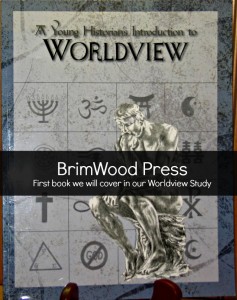
BrimWood Press Young Historians Intro to Worldview A Young Historian’s Introduction to Worldview

This is the book we will start with.  It is only four lessons long but this is where we learn the meaning of what a worldview is, how it impacts our culture and history, and how important it is to our daily lives.  A person’s worldview effects how they view every challenge, every hurdle, every thing both positive and negative that happens in their life and actually, life itself … so its importance cannot be overstated.  This book will introduce my children to the basic core beliefs of four worldview families:  Naturalism, Pantheism, Monotheism and Polytheism and within those categories we learn about the various religions (i.e., Islam, Buddhism, Judaism, Christianity, Atheism, etc).  It uses hands-on activities to teach the abstract concept of worldview, which of course is so like a Montessori friendly curriculum!  The guide includes an eighty six-page workbook, nine pages of cardstock, pre-cut wrapping papers and three 6″ x 6″ boxes.  Oh and 3d glasses!  I can’t wait to see how this comes together!  

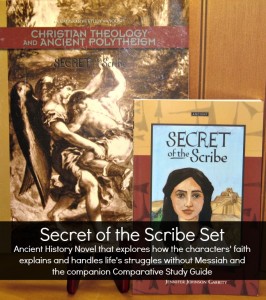
BrimWood Press Secret of the Scribe SetBrimWood Press has a new series of historical novels entitled “Engaging Thinkers” that further develops the worldview investigation. This series reminds me of the Henty books.  Each novel introduces the worldview of various religions that are completely without our Messiah.  The main characters all deal with life struggles and we learn how they evaluate and explain these struggles through their particular worldview and religion.  We will only be reviewing the novel for Ancient history, but there are four novels, covering major chronological periods of history: ancient, medieval, early modern and modern. Each novel focuses on a different worldview family: polytheism, monotheism, naturalism and pantheism. We already read the Henty books, so this seems like a logical extension and the natural flow for my boys! Again, this curriculum really seems to fit our homeschool environment!   

Companion Guide to Secret of the Scribe:  
Christian Theology and Ancient Polytheism: 

Where the Ancients meet their Maker. 

This book is the companion study guide for the Secret of the Scribe entitled: Christian Theology and Ancient Polytheism (CTAP).  It is designed to be a nine month curriculum that compares and contrasts ancient Near Eastern myths with the Torah and Tanakh (“Old Testament”) accounts of biblical events. We will explore via an in-depth study, the ancient struggle with idolatry. CTAP takes a literary approach and combines it with the method of comparison and contrast to cultivate higher level thinking skills.  
If you are interested in learning more about this set prior to my review, visit BrimWood Press and download these samples:

Brimwood Press’ CTAP – Course Overview Sample – Sample Download – .5 MB

Other companion products recommended for use with this Study Guide: Secret of the Scribe

So stay tuned as we work through this worldview curriculum over the next few months!  I will be blogging more about it as we start reading the books and materials … giving you my unbiased opinion of the hands-on aspects, the text and the worldview perspective.  We are planning to finish this study over the summer.  

If you intend to purchase this curriculum based on my introduction and review of the curriculum, I would so appreciate you using our affiliate link to do so.  The curriculum will not cost you more, but it will provide a small commission to us.  I actually intend to use any proceeds to purchase the rest of the worldview curriculum! http://brimwoodpress.com/idevaffiliate/idevaffiliate.php?id=1026.  Thank you!

Until next time… take care of your family and hug your children! We never know what tomorrow holds.  

If you like this post, please share it!

  • Share on Facebook (Opens in new window) Facebook
  • Share on Pinterest (Opens in new window) Pinterest
  • Share on X (Opens in new window) X
  • Print (Opens in new window) Print
  • More
  • Email a link to a friend (Opens in new window) Email
  • Share on Reddit (Opens in new window) Reddit
  • Share on LinkedIn (Opens in new window) LinkedIn
  • Share on Tumblr (Opens in new window) Tumblr

Like this:

Like Loading…

Help with Identification and Treatment of Bumblefoot

May 2, 2013 By: Gage7 Comments

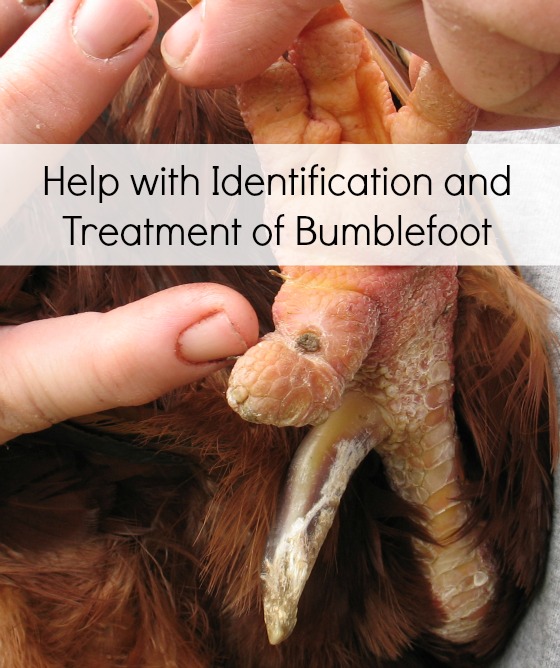
Good Afternoon! The other day I was outside playing and my brother, Blake, came out and said “we have a problem with Rocky!”  Rocky, our Rhode Island Red Rooster, was limping.  Rocky is about 3 years old.  He was limping so much that I could catch up with him and sit him in my lap (which I have never been able to do before).  I inspected his feet to see if I could see a problem and it appears he has an infection called Bumblefoot.  Bumblefoot is an infection chickens and chicks can get from walking on hard surfaces which can cause cuts to the chicken/chick feet where bacteria can enter and cause an infection.  What I’ve read doing research says when a chicken has Bumblefoot there will be an iconic scab.  I think this is what Rocky has on his foot.  Here are some pictures of Rocky’s foot:

Bumblefoot


Bumblefoot Identification Top View

I am not sure how to treat the infection.  I have seen and heard many ways to clean out the infection and stop the pain.   I have been researching what to do and I found this list on the Chicken Chick‘s site where she describes one way to treat Bumblefoot.  I’ve copied it below:

  • peel off the scab after soaking the foot in Betadine mixed with water
  • then squeeze the infection out
  • if it is stuck, cut a little bit with a sanitized knife until you get the infection out of the foot
  • then apply Vetericyn
  • after applying Vetericyn wrap foot (or pinkie toe in our case) with vet tape or gauze.

Please, can someone confirm that this is Bumblefoot.  And please let me know if this is the right treatment!  Or if I need to do something else.  

Thank you!   See ya’ soon….

If you like this post, please share it!

  • Share on Facebook (Opens in new window) Facebook
  • Share on Pinterest (Opens in new window) Pinterest
  • Share on X (Opens in new window) X
  • Print (Opens in new window) Print
  • More
  • Email a link to a friend (Opens in new window) Email
  • Share on Reddit (Opens in new window) Reddit
  • Share on LinkedIn (Opens in new window) LinkedIn
  • Share on Tumblr (Opens in new window) Tumblr

Like this:

Like Loading…
« Previous Page
Next Page »
  • Pinterest
  • Facebook
  • Twitter
  • Google+
  • Sulia

Subscribe to our blog

Email

HHMTeamMember3-01

Winner-Top-Ten-BlogDesign10

Top Posts

  • But I Don't Want to be the Policeman!
    But I Don't Want to be the Policeman!
  • Hands-on Activity for Studying Globes and Maps
    Hands-on Activity for Studying Globes and Maps
  • Start a Home Economics Class in Your Homeschool
    Start a Home Economics Class in Your Homeschool
  • Brimwood Press Worldview Curriculum Review
    Brimwood Press Worldview Curriculum Review
  • nature journal post 2
    nature journal post 2

Affiliates / Sponsors

Give lynda.com

Shop Montessori Services

Newsletter Affiliate

We create and distribute our newsletter via MadMimi! It is SOOO easy to use! I highly recommend it!
Mad Mimi Email Marketing

Grab A Button

LiveAndLearnFarm.com Just select and copy the code below.
<a href="http://www.LiveAndLearnFarm.com" target="_blank"><img src="http://www.LiveAndLearnFarm.com/blog/wp-content/LiveLearnFarmButton.jpg" alt="LiveAndLearnFarm.com" width="125" height="125" /></a>

Copyright © 2026 · Modern Blogger Pro Theme By, Pretty Darn Cute Design

Loading Comments...

    %d