
Live and Learn Farm

  • Home
    • About Us
    • Contact Us!
  • HomeSchool
    • All Inclusive
    • Apologia
    • Arts
    • Bible
    • Civics
    • Current Events
    • Curriculum
    • Elementary
    • Geography
    • History
    • Language Arts
    • Math
    • Middle School
    • Montessori
    • Other
    • Practical Life Skills
    • Science
    • Writing
  • Link Ups
    • Monday Middle & High School Link Up
  • Montessori
  • Teen Blogs
    • Gage – 13 Years Old
    • Chase – 14 Years Old
    • Blake – 10 Years Old
  • Shop
    • Cart
    • Checkout
    • My Account
  • Free!!!
  • Other Topics
    • Blogging
      • Facebook Series
    • Farmstead
      • Chickens
      • Cows
      • Permaculture Garden
    • Mom
You are here: Home / Archives for Trish Corlew

How to Make a Compass

June 11, 2013 By: Trish Corlew8 Comments

How to Make a Compass

Disclosure

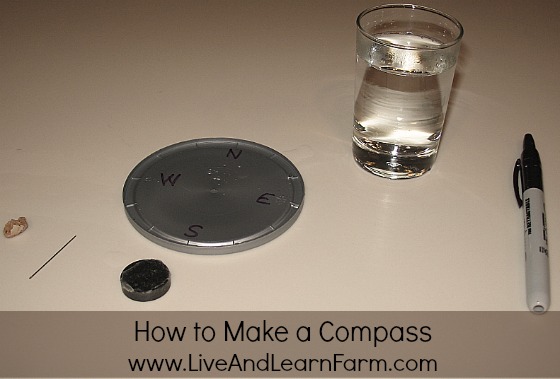
As part of our Paths of Exploration curriculum for the Christopher Columbus unit, we decided to research how to make a compass. We found an easy 20 minute project and decided to make it!!  The boys completed a Scientific Speculation Sheet from our Apologia Curriculum and added this to their Paths of Exploration Student Notebook.  Below are the details for how to make a compass! 

Materials List:

  • A Small Piece of Cork
  • A Sharpie
  • A Plastic Lid
  • A Needle
  • A Magnet

Directions:

1.    Write the initial for the cardinal directions on the inside of the plastic lid (see picture at the top of the post).  

2.    Place the lid on the table with the “N” pointing North.  

3.    Once the ink dries, fill the lid with water.  
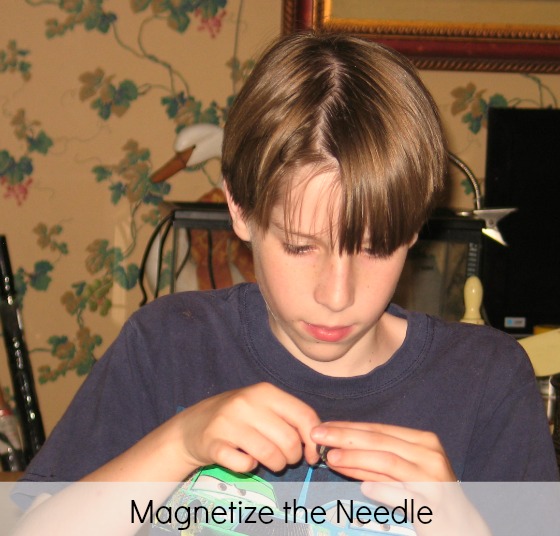
Magnetize Needle

4.    Take the magnet and brush the needle over it moving your hand in the same direction several times (do not go back and forth, just one direction).
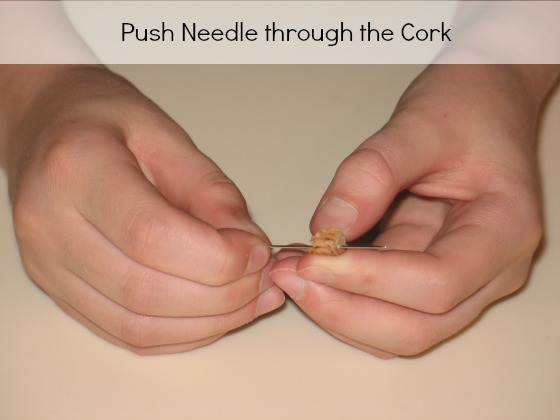
Compass Needle Cork

5.    Push the needle through the small piece of cork.  Be sure the cork will be able to float freely in the water in the plastic lid before you push the needle through.  

6.    Place the needle and cork in the water.  One end of the needle should be pointing North.  

7.    Turn the lid now to see what happens.  Document the results.

So What Is happening?  

Magnetic fields contain a force that is created by moving electrical charges. The Earth produces a magnetic field  and this field is quite weak. It is sufficiently strong enough to align magnetized objects, such as the needle in our compass. By floating the needle on the cork, you allowed it to rotate freely. So the needle became lined up with Earth’s magnetic field and points toward the north or south pole of the planet.  

For a very detailed middle / high school level explanation of what is happening with the magnetism, see this GREAT article on Magnetism by Dr. Lensyl Urbano (PhD Geology and Geophysics) from Montessori Muddle.  I’ve been following this blog for a while and it is one of my favorites for upper level science with a hands-on perspective.  

As we work through the Paths of Exploration curriculum this summer, there will be lots more hands-on posts, so stay tuned!  

Until next time…. 


If you like this post, please share it!

  • Share on Facebook (Opens in new window) Facebook
  • Share on Pinterest (Opens in new window) Pinterest
  • Share on X (Opens in new window) X
  • Print (Opens in new window) Print
  • More
  • Email a link to a friend (Opens in new window) Email
  • Share on Reddit (Opens in new window) Reddit
  • Share on LinkedIn (Opens in new window) LinkedIn
  • Share on Tumblr (Opens in new window) Tumblr

Like this:

Like Loading…

Paths of Exploration Columbus Lesson 1 Part 1

June 11, 2013 By: Trish Corlew7 Comments

Columbus Study


Disclosure

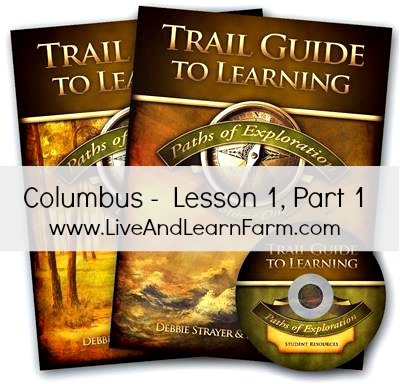
Launch Day!  We started Paths of Exploration by Trail Guide to Learning today!  As most of you know, we homeschool with a very hands-on (Montessori-ish) approach to education, so we are using lots of  supplemental resources to augment this course.  We are doing the entire Paths of Exploration as an intensive study over the summer, so there will be lots of territory covered in my posts!   As I post these articles, I will also be giving reviews of their product in a real-world, running review of this curriculum. This article is about Paths of Exploration Columbus Lesson 1 Part 1.


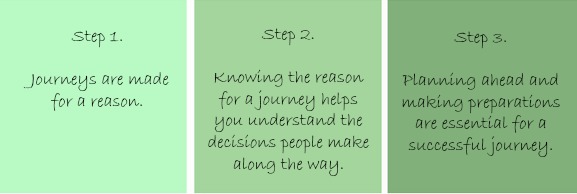
Steps for thinking


We decided to do the upper elementary section for all of Columbus first and then circle back and do the Middle School supplement curriculum after we finish Columbus Upper Elementary curriculum.  That way, all of the boys have the foundation that the Upper Elementary curriculum lays first before we jump into a more extensive Columbus Middle School study.  Besides, we are just figuring out the style of this curriculum and I’m already seeing areas that need to be refined and cleaned up! But we are going to do Columbus Unit pretty much as it is presented in both the Upper Elementary and the Middle School texts with a few minor modifications. After we have completed both texts, we may decide to modify our approach.   

Section A is Copywork/Dictation with “Language Skills” being the area mentioned as the target for this section.  I really thought I would skip this section before we started, but I decided to teach ColumbusHandwriting without Tears pretty much as it is presented and I am glad I did (at least for this section).  It is good for them to hear poetry and to try to transcribe it from my dictation. Any missed words become part of their vocabulary words for that week. It was fun and it is a great way for me to keep their handwriting skills up. All of the boys are excellent at writing (Thank you Handwriting without Tears!)… and yes, they learned how to write cursive!!  The dictation was from an original poem by Debbie Strayer (one of the authors).  

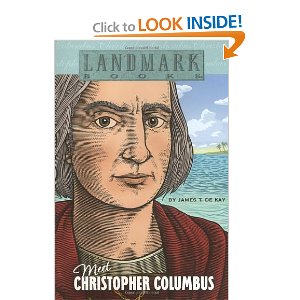
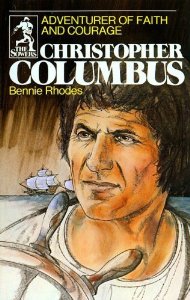
Section B is Reader with “Language Skills, Thinking Skills, and History” listed as the areas targeted by this work area. This is where everything was terribly mixed up!  There are two required reading books about Christopher Columbus. One is Meet Christopher Columbus Meet Christopher Columbusand the other is Christopher Columbus.  Since the names are so close, it would have been helpful if they explained which one to read from (maybe giving the author each time).  

Section C is Read-Aloud and Discussion and the targeted areas for this section are “Language Skills, Thinking Skills and Writing”.  I have no idea why there are two sections both with a focus on reading aloud.  This is why it was confusing.  In Section B it says “read one or two pages aloud” but in Section C it states “listen as your teacher reads pages 1-6 aloud”.  The boys JUST read pages 1-2 aloud and now I’m reading these same pages again? I thought maybe I had the boys read the wrong book aloud, but no, it’s the same book Christopher Columbus.  So, this was confusing.  We have two hard copies of both these books for us to use but I also purchased a Kindle version of Meet Christopher Columbus and the boys all downloaded it onto their Kindles for Christopher Columbustheir read aloud sections.  I had all three boys take turns reading paragraphs.  The Bennie Rhodes book was not available as a Kindle download.  Anyway, they really enjoyed being able to read it from their own Kindles (and even figured out how to have their kindles read to them… LOL)!  The discussion question was terribly basic for this age group (What do you think Christopher Columbus’ dream was when he was a young boy?”.  Both books we read aloud provided the answer.  If you were paying half a second of attention, you would have this question answered.  Maybe that was the point for the first Lesson, but the boys could have handled a much more thought-provoking question!  

Section D is Word Study. The areas focused on with this section are “Spelling, Phonics and Vocabulary”. For this one the authors discuss “long I” words from the original poem that were part of the copy/dictation work from Section A.  This was very basic also for upper elementary students.  We did it but we will augment the next lesson to add more challenging words!  There was also a discussion here about the prefix “un” and how it was used in the reading from Sections B and C.  They provide an area for the students to list 6 words that start with “un” and define them.  This was pretty fun for them, but still very basic. 

un equals not

globe

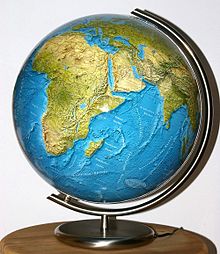
Also as part of Section D we located cities in Italy on the globe. We loved this part and the boys did great… just one thing, the next section (section E) is Geography.  Why did they put this under Section D, Word Study?  I have to assume it was a mistake.  They also had to identify port cities in the US after defining what a “port” is.  With the help of the globe, they listed out several from both coasts.  That was a fun activity as well.  

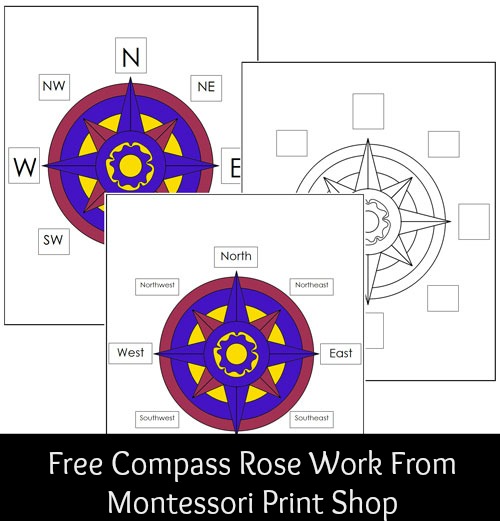
Like I just mentioned, Section E is Geography with the area targeted being listed as “Science”.  Here we are learning about a compass.  We did the worksheets for the CompassRose-MPScompass but we also printed out this great compass work from Montessori Print Shop. Since we love hands-on learning, we decided to create our own compass. Here is that post.    

Section F is Writing with “Thinking Skills” being listed as the area being targeted. The boys were to list the details of Columbus’ birthday as described in the text.  Then list the details from a typical birthday for them.  In the student notebook is a Venn diagram where they would list the individual traits for each and the common traits.  Great exercise!  

Finally, Section G is Independent Reading.  At the beginning of the provided student notebook is a reading list. The independent reading section is meant to be just thirty minutes of fun reading. However, this is exactly what they do every night already, so we have modified this a little bit so they can read anything about Christopher Columbus for thirty minutes on Wednesdays and Sundays. We have quite a few Columbus books in our library from coloring books and picture books to exhaustive studies … so they should not run out of material to read for a while. I wrote a post to share our library resources, you can find it here.  One other modification I have made is I added in an art component.  All of my boys took Drawing this past year as an elective, so on Tuesdays and Thursdays, they are going to spend thirty minutes each day drawing something that is applicable to the subject we are studying.  They do not have to complete their drawings the same day or even the same week. I can’t wait to see what they come up with!  

We are year-round homeschoolers, however most of the curriculum the boys were working on during the year they have completed.  So this curriculum is a great way to keep many of the skills the boys have acquired over the year fresh and to dive into a new subject.  In addition to this curriculum, the boys are keeping their math going all year.  So their workload is dramatically reduced during the summer.  I know some may be wondering why we do this.  Well, we quickly realized after that first summer off from homeschooling that it was quite hard to get back into the routine.  We decided (with the boys) that we would have a dramatically reduced schedule, but would keep going during the summer months.  For me, this curriculum is an experiment.  I have been toying with the idea of using an all-inclusive curriculum for a couple of years;  one where all the subjects (with the exception of Science and Math) are covered and are integrated.  This curriculum may or may not be the right one for an all-inclusive, but this was a great one to test the concept with.  I’ll give you more feedback on that as we work through this curriculum.  I hope these posts will be a blessing to you and your family!  If so, leave me a note!  

Until next time…. 
We are connecting this week with the Ultimate Homeschool Link-up.  Be sure to visit them and the other bloggers linked there, they all have GREAT posts!  I especially love the Firefly one!

 The Homeschool Village

If you like this post, please share it!

  • Share on Facebook (Opens in new window) Facebook
  • Share on Pinterest (Opens in new window) Pinterest
  • Share on X (Opens in new window) X
  • Print (Opens in new window) Print
  • More
  • Email a link to a friend (Opens in new window) Email
  • Share on Reddit (Opens in new window) Reddit
  • Share on LinkedIn (Opens in new window) LinkedIn
  • Share on Tumblr (Opens in new window) Tumblr

Like this:

Like Loading…

Philosophy Adventure Giveaway and Launch Party

May 31, 2013 By: Trish Corlew4 Comments

philosophy adventure 4


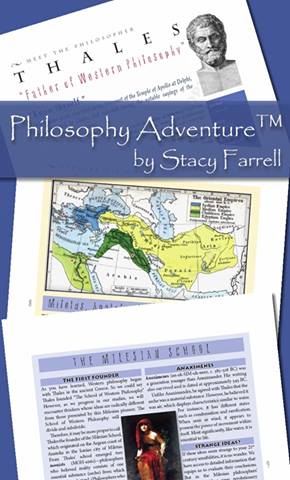
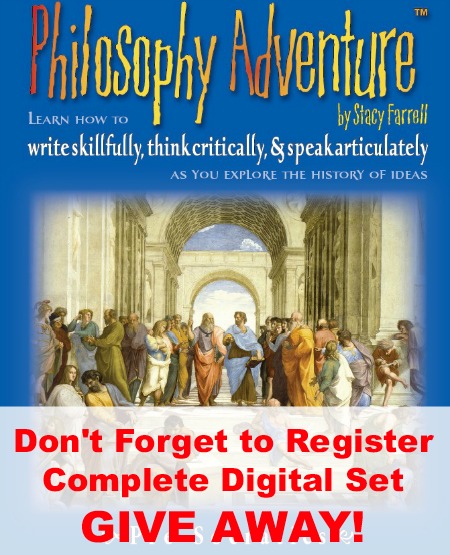
I am excited to tell you about a new Homeschool Curriculum called Philosophy Adventure by Stacy Farrell at Homeschool Adventure Co. I was asked to be a part of their launch team and I am thrilled to have found this curriculum. So, welcome to our Philosophy Adventure Giveaway and Launch Party! I was given a digital copy of this curriculum, in exchange for my honest opinion and assistance in finding those pesky little typos that sneak through the editing process (as all of us bloggers know oh too well).  I do not and will not receive any compensation for my review other than the curriculum mentioned above!  Be sure to read to the bottom of the post where you can register to win a free digital copy of the complete curriculum!  

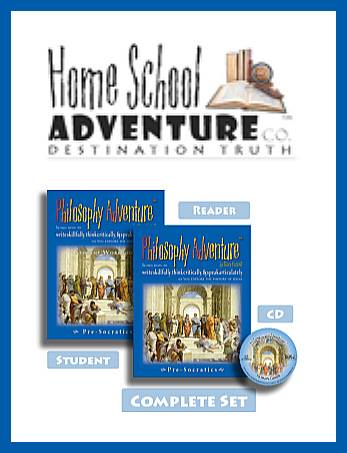
So, Let me introduce you to Philosophy Adventure. It was written by Stacy Farrell and is designed for students in the 6th – 12th grades.  We will be using this curriculum next year with our 8th, 7th and 4th graders.  It will be a little stretch for my youngest, but we will be able to modify it to fit his skill set.  Philosophy Adventure™ helps our children cultivate and defend a biblical worldview by teaching them how to write skillfully, think critically, and speak articulately as they explore the history of philosophy and the impact of ideas.

I know “Philosophy Adventure” sounds like it is all about philosophy, which is overwhelmingly not Biblical at all, but I can assure you it’s much more than just a curriculum about philosophers!  The study examines the pre-Socratic philosophers, what they taught, thought, what and who influenced their thinking and who they interacted with.  But most importantly, it introduces their teachings from the perspective of how does it fit with a biblical worldview.  So, it asks the question and our students answer…  how does each of these philosophers’ view match or conflict with a Biblical worldview.  Although this material can be used for our children to work independently, I think it is far more valuable as a tool to provoke thoughtful and deep discussion for the entire family!  

Philosophy Adventure 2

As most of your know, we have a Montessori slant to our homeschool environment.  One of the foundational principles of a Montessori education is that of being life long learners.  Ironically, Stacy mentions in the introduction:

We consider ourselves students rather than scholars.  Life-long learners.

AND, not only is Stacy’s educational philosophy in-line with our Montessori leanings, but there are also Memory Cards that we fully intend to use to create a board game; a timeline that shows not only the philosophers, but also is color coded to show the Rulers, Prophets, Biblical Heroes, Scientists, Literary Works and Major Events of their time; Map and geography work; a Write, Think and Speak Journal; and more!  It meshes so well with the way we homeschool!  I know this is so much information to absorb!  Download a sample lesson and see what you think for yourself!  I will give a full review in the next couple of weeks, but I really wanted to introduce you to the curriculum and tell you I already love it!  Here is their promotional video that does a great job at giving you a quick preview of this wonderful curriculum!


Here is what is included in each lesson of Philosophy Adventure:

  • Meet the Philosopher where we learn the philosopher’s story
  • Sections for in-depth study where the students Write, Think, and Speak about what they are studying
  • Geography and Map studies
  • The School of Thought associated with the philosopher
  • And finally a Contrast section which provides primary source materials (or secondary if primary is unavailable) from the philosopher, and the “Biblical Worldview” where the text discusses if the philosopher’s ideas align with a biblical worldview.

Along with the primary text, a Student Workbook and Teacher Resources are included. The Write, Think and Speak journal is in the Student Workbook, along with Map work, writing and speaking checklists and Vocabulary.   In the teacher resources’ section are the memory cards, timelines to print, and the quizzes and answer keys.

Philosophy Adventure is available in several different formats:

  • Complete Set of Printed Text and Student Workbook with Resources CD – $89.95

  • Reader with Resources CD (includes digital rather than print edition of Student Workbook) – $69.95

  • Digital Edition of Reader & All Resources on CD – $49.95

  • Digital Download Edition – $39.95

 PA Giveaway


Be sure to subscribe to their newsletter so you can be notified of updates and new volumes of the curriculum! 

Now for the fun part… we have been given a digital download, including reader, student workbook, and teacher resources to give away to one of our readers!  Good luck!!

Entry-Form


Philosophy-disclaimer

If you like this post, please share it!

  • Share on Facebook (Opens in new window) Facebook
  • Share on Pinterest (Opens in new window) Pinterest
  • Share on X (Opens in new window) X
  • Print (Opens in new window) Print
  • More
  • Email a link to a friend (Opens in new window) Email
  • Share on Reddit (Opens in new window) Reddit
  • Share on LinkedIn (Opens in new window) LinkedIn
  • Share on Tumblr (Opens in new window) Tumblr

Like this:

Like Loading…

BrimWood Press Worldview Curriculum

May 9, 2013 By: Trish Corlewcomment


Brimwood Press


Disclosure

We are so excited to be one of the homeschooling families that will be reviewing BrimWood Press’ Worldview curriculum, designed for students in 5th through 8th grade. The curriculum is only four lessons and the lessons are presented through stories (similar to Henty books), with hands-on activities and discussion questions.

Being Messianic, it has been a challenge to find a worldview curriculum that matches our beliefs, so we can’t wait to start this curriculum since it is written without any particular denomination slant! This could be the answer to our challenge!  So many worldview products dismiss the “Old Testament” and that is completely unacceptable for our faith!  

The products we will be reviewing are:

BrimWood Press Young Historians Intro to Worldview A Young Historian’s Introduction to Worldview

This is the book we will start with.  It is only four lessons long but this is where we learn the meaning of what a worldview is, how it impacts our culture and history, and how important it is to our daily lives.  A person’s worldview effects how they view every challenge, every hurdle, every thing both positive and negative that happens in their life and actually, life itself … so its importance cannot be overstated.  This book will introduce my children to the basic core beliefs of four worldview families:  Naturalism, Pantheism, Monotheism and Polytheism and within those categories we learn about the various religions (i.e., Islam, Buddhism, Judaism, Christianity, Atheism, etc).  It uses hands-on activities to teach the abstract concept of worldview, which of course is so like a Montessori friendly curriculum!  The guide includes an eighty six-page workbook, nine pages of cardstock, pre-cut wrapping papers and three 6″ x 6″ boxes.  Oh and 3d glasses!  I can’t wait to see how this comes together!  

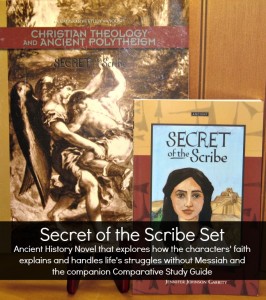
BrimWood Press Secret of the Scribe SetBrimWood Press has a new series of historical novels entitled “Engaging Thinkers” that further develops the worldview investigation. This series reminds me of the Henty books.  Each novel introduces the worldview of various religions that are completely without our Messiah.  The main characters all deal with life struggles and we learn how they evaluate and explain these struggles through their particular worldview and religion.  We will only be reviewing the novel for Ancient history, but there are four novels, covering major chronological periods of history: ancient, medieval, early modern and modern. Each novel focuses on a different worldview family: polytheism, monotheism, naturalism and pantheism. We already read the Henty books, so this seems like a logical extension and the natural flow for my boys! Again, this curriculum really seems to fit our homeschool environment!   

Companion Guide to Secret of the Scribe:  
Christian Theology and Ancient Polytheism: 

Where the Ancients meet their Maker. 

This book is the companion study guide for the Secret of the Scribe entitled: Christian Theology and Ancient Polytheism (CTAP).  It is designed to be a nine month curriculum that compares and contrasts ancient Near Eastern myths with the Torah and Tanakh (“Old Testament”) accounts of biblical events. We will explore via an in-depth study, the ancient struggle with idolatry. CTAP takes a literary approach and combines it with the method of comparison and contrast to cultivate higher level thinking skills.  
If you are interested in learning more about this set prior to my review, visit BrimWood Press and download these samples:

Brimwood Press’ CTAP – Course Overview Sample – Sample Download – .5 MB

Other companion products recommended for use with this Study Guide: Secret of the Scribe

So stay tuned as we work through this worldview curriculum over the next few months!  I will be blogging more about it as we start reading the books and materials … giving you my unbiased opinion of the hands-on aspects, the text and the worldview perspective.  We are planning to finish this study over the summer.  

If you intend to purchase this curriculum based on my introduction and review of the curriculum, I would so appreciate you using our affiliate link to do so.  The curriculum will not cost you more, but it will provide a small commission to us.  I actually intend to use any proceeds to purchase the rest of the worldview curriculum! http://brimwoodpress.com/idevaffiliate/idevaffiliate.php?id=1026.  Thank you!

Until next time… take care of your family and hug your children! We never know what tomorrow holds.  

If you like this post, please share it!

  • Share on Facebook (Opens in new window) Facebook
  • Share on Pinterest (Opens in new window) Pinterest
  • Share on X (Opens in new window) X
  • Print (Opens in new window) Print
  • More
  • Email a link to a friend (Opens in new window) Email
  • Share on Reddit (Opens in new window) Reddit
  • Share on LinkedIn (Opens in new window) LinkedIn
  • Share on Tumblr (Opens in new window) Tumblr

Like this:

Like Loading…

Homeschooling on the Beach Part 2

May 2, 2013 By: Trish Corlew2 Comments


Homeschooling on the Beach Part Two


Disclosure

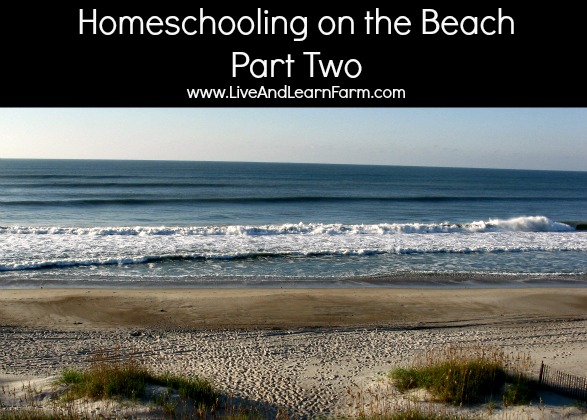
In Homeschooling on the Beach Part 1, we spent some time laying the foundation of geography and travel prior to taking your vacation.  In Part 2, I’m picking up once you are at the beach.  If you have not read part 1, you can find it here.

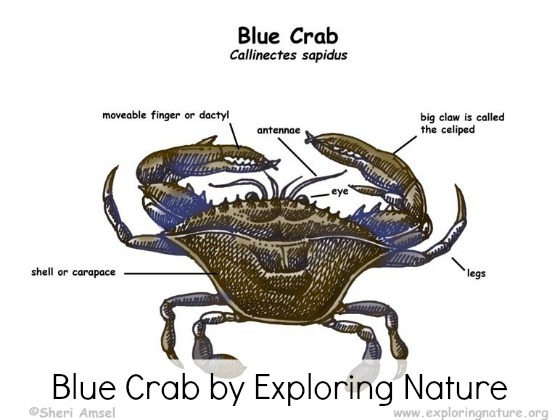
Blue Crab Exploring Nature

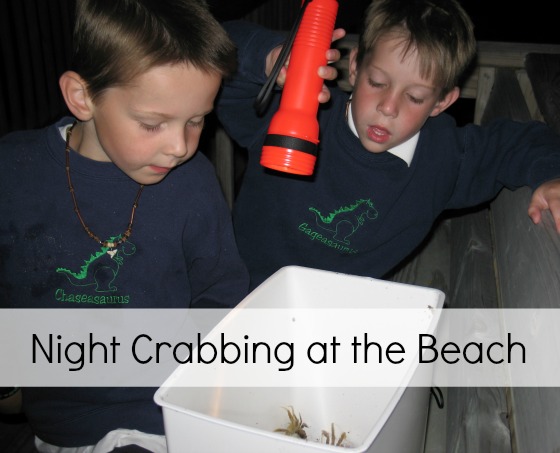
One creature you will most likely find on any beach any where, is the crab.  Crabs are crustaceans as are shrimp and  lobsters.  Crustaceans have exoskeletons… “Exo” refers to outside, so an exoskeleton is a skeleton on the outside of their body.  But did you know barnacles are crustaceans too?  Heck, I’m not sure I even knew they were alive until we did this study!  Montessori Materials has a free download of nomenclature cards for Crustaceans.  Science Teachers has some cards as well (not 3 part cards).  Exploring Nature has some great coloring pages and labeling pages for Crustaceans as well.  If you have never gone crabbing, now is the time!  You can either crab off a salt water dock or do what we like to do… get a net, a flash light and a bucket and catch them at night by catching them on the beach in the dark!  It is so much fun!  This is one of our pictures from years ago of two of our little ones examining the crabs after we have been crabbing.  I love those little faces!!!  


Beach 4 edited


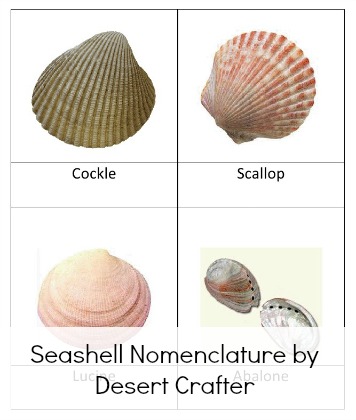
Seashell Nomenclature by Desert CrafterI’m from the coast of North Carolina and I remember the first time I went to a beach on the Gulf of Mexico, I was shocked to not find any shells!  I am a sheller, big time!  I was completely lost that vacation not being able to shell hunt!  This is a great study, and for a sheller like me, a MUST do!  There are primarily two kinds of shells, Bi-valves and gastropods (sometimes called uni-valves).  Here is a Shell Sheet I saved when we took our trip a couple of years ago.  I’ve hunted online to find where I got it so I can give credit with no luck.  If you happen to know, send me an email so I can give credit!  I found these 3 part cards for sea shells and couldn’t wait to share them!  These were made by Desert Crafter who has a ton of other wonderful Shell works!   Montessori Print Shop has a beautiful free set as well!  


Be sure to pick up lots of shells to bring back with you (and maybe even a bucket of sand and a bottle of salt water)!  You can use the shells for various sorting works, for identification, for counting, and for matching to the 3 part cards above.  Here is a great site to help with the identification of shells.  


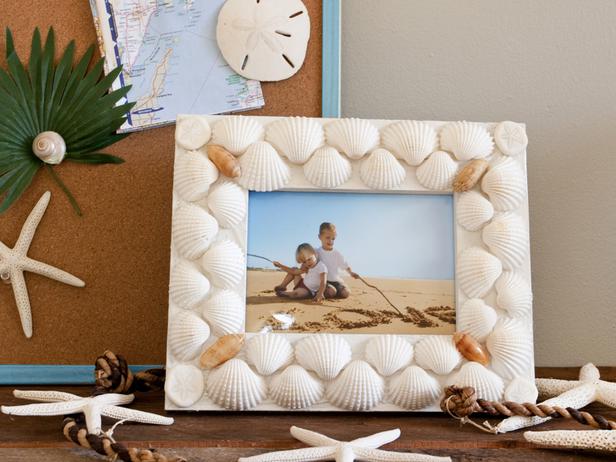
Seashell frame insructionsOr you can use them to make a frame to put your favorite vacation picture in!  Here is a lesson on doing that!  Confession:  I still have all the shells and picture frames to make our frames from three years ago and haven’t yet!!  Maybe if we can’t go to the beach this year, we can at least do that!  If I do, I’ll be sure to post the how to’s and the final pictures when we are through!  

Once you are at the beach, always look for the tide pools!  They are brimming with all kinds of life and other interesting items that got trapped from the ocean!  Look for living creatures first… and try to identify them.  


Have you ever wondered what the secret is to those fabulous sand castles you sometimes see on the beach?  Here is your answer!  

There are several videos in this series, so be sure to watch them all!  Now, after learning how to build these fabulous sand castles, it seems appropriate to study why the water and sand work together this way.  Here are a couple of interesting links on sandcastle physics and thermodynamics!

  • Castles in the sand
  • Perfect Sandcastle Uses Little Water In Lots Of Sand, Scientists Say

There may be one more post in this series.  I’ll try to get it posted before summer, LOL!!!!  Have a great trip to the beach with your little ones! Our goal is for school and life to blend into an indistinguishable blur of fun, challenge and education!  I hope you guys can find that balance!  

Until next time…

If you like this post, please share it!

  • Share on Facebook (Opens in new window) Facebook
  • Share on Pinterest (Opens in new window) Pinterest
  • Share on X (Opens in new window) X
  • Print (Opens in new window) Print
  • More
  • Email a link to a friend (Opens in new window) Email
  • Share on Reddit (Opens in new window) Reddit
  • Share on LinkedIn (Opens in new window) LinkedIn
  • Share on Tumblr (Opens in new window) Tumblr

Like this:

Like Loading…

Review of Excellence in Writing Geography-Based Writing Lessons

May 1, 2013 By: Trish Corlew9 Comments

My review of

Disclosure

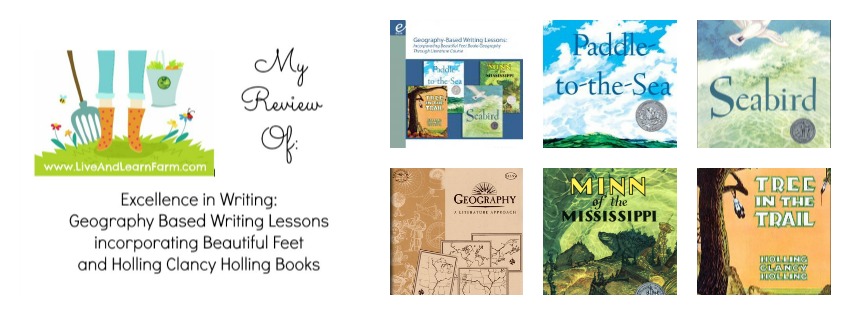
We are about to wrap up the 2012-2013 school year.  That means it is time for me to assess what is working and not working in our homeschool and to do some reviews on the curriculum we used.  So, this is the first of many reviews coming!  Let me start by saying, this is not a paid or sponsored review. I will be doing reviews in the future on products that were given to me in return for my honest opinion, but this review of Excellence in Writing Geography Based Writing Lesson is strictly just me speaking from my own opinion and experience on a curriculum I purchased.  

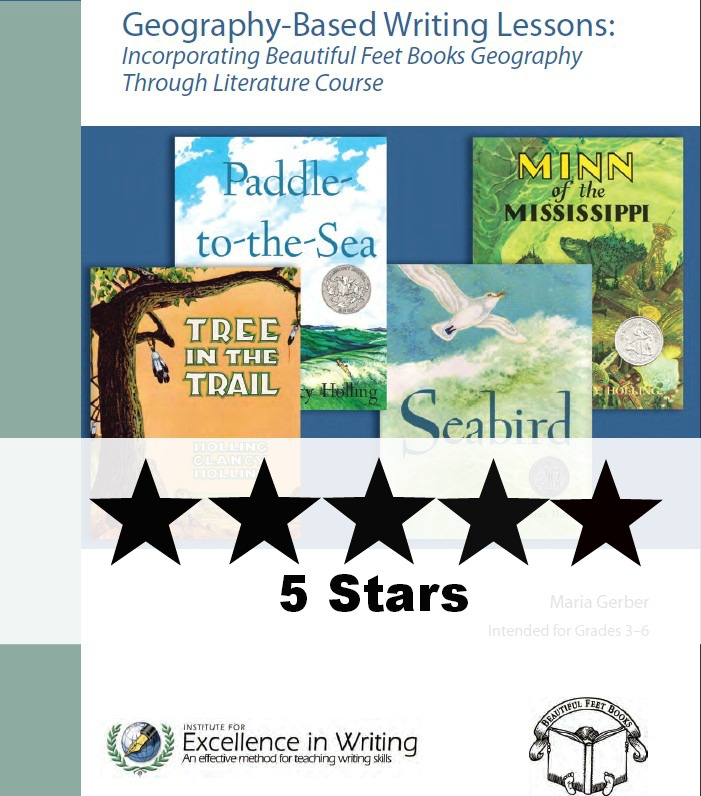
I had been hunting a writing curriculum for a couple of years and we’ve experimented with a few that were pretty lackluster (I’ll write reviews on them later)!  I had been hearing great things about Excellence in Writing (IEW) for years but, I’ll be honest, I was too intimidated to try it!  It took me three years of homeschooling experience under my belt to build up the fortitude to try IEW.  Even then, I tip-toed into the IEW waters with their Geography based writing lesson using Beautiful Feet for Geography and a few of Holling Clancy Holling’s books.  

Foundation for the review, our Homeschool Environment:

I think it matters the ages and gender of the children that were taught the material.  So, my experience and opinion is based on the success with my boys, ages 13, 11, and 9 years old.  Since this curriculum is recommended for children in Grades 3 – 7, it is the exact range of my children!  

We had not read these wonderful books by Holling Clancy Holling, so even without the IEW curriculum, these were such a treat in and of themselves!  The boys loved them!!  They would read the homework assignments and would regularly read ahead and usually go ahead and finish the book in the first sitting.  This was fine because we also read the books out loud in class and these readings were inline with the homework as it was assigned.  We did Literature/Writing one day a week for three hours a day, plus homework.  They probably spent no more than five hours a week on this topic.  

IEW Geography Review:

I will give you details about the first book we read Paddle to the Sea in this curriculum and provide details step by step of what we did.  The first lesson in Paddle to the Sea was using keywords to outline various texts from the book.  Once they had created outlines of the keywords, they then had to paraphrase the paragraph back using one of their brothers’ notes!  This was so much fun for the boys to figure out how to identify the key words in a text and they loved creating  symbols instead of words to get to the most basic outline possible!  We quickly realized there is an art to using symbols to understand and relate back the text.  You can find some common note-taking symbols online by doing a simple google search but I challenge you to go further.  It will make it so much more fun for your children!  

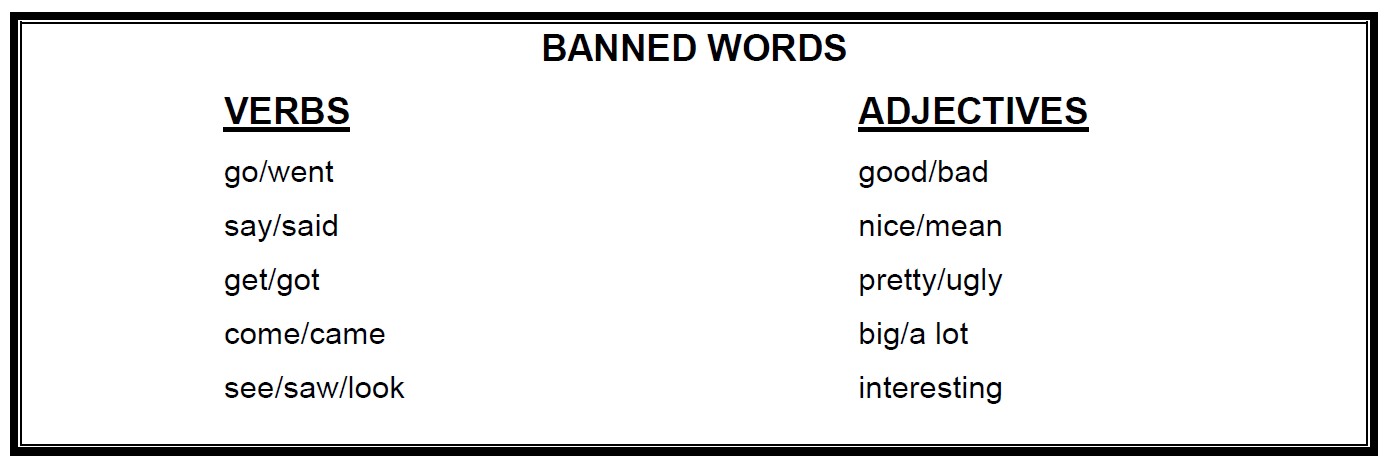
In Lesson Two, we learned all about the “Banned Word List”.  This was another extremely fun activity for the boys.  They had to figure out words to use instead of the common words listed on the banned word list.  Here are the banned words that could not be used when reporting on Paddle to the Sea (and the rest of the books from here on out):

IEW Banned Words  

They took great pleasure in catching each other using one of the banned words!  The IEW PDF download provides a form for these banned words and ideas of words we could use to replace them.  

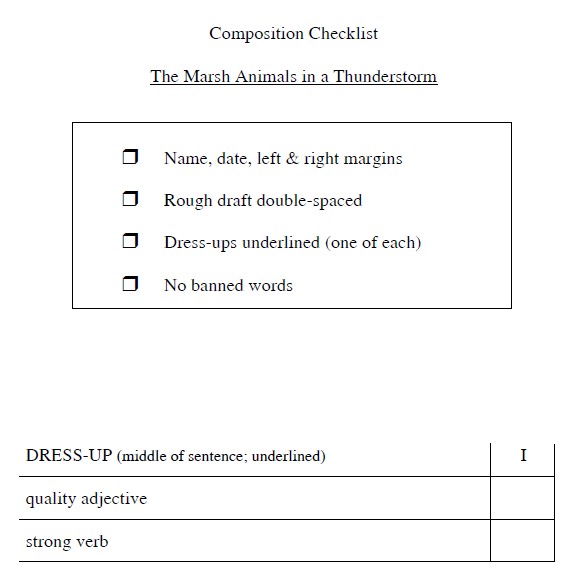
IEW Composition Checklist

Lesson Three is writing from notes.  The boys wrote a one paragraph report on the Marsh Animals in a Thunderstorm.  They started with a keyword outline summarizing the text they read.  They then were assigned a one paragraph report based on the keyword outline.  They used this checklist which is part of the IEW Geography Course.   

In Lesson Four, the boys are introduced to “Dress ups”.  The first set are the quality adjectives and strong verbs.  This concept is practiced through Lesson Five.  In Lesson Six the boys were introduced to the next dress-up which was -ly words.  Of course, “ly” words are adverbs, so they are adding adverbs into their writing now.  

We have now reached Lesson Eight in our review and we are at the climax of the Paddle to the Sea.  So you can see, it has a nice progression of stepping into the writing assignments and giving our children lots of time to get comfortable with the material before moving on to the next concept.  

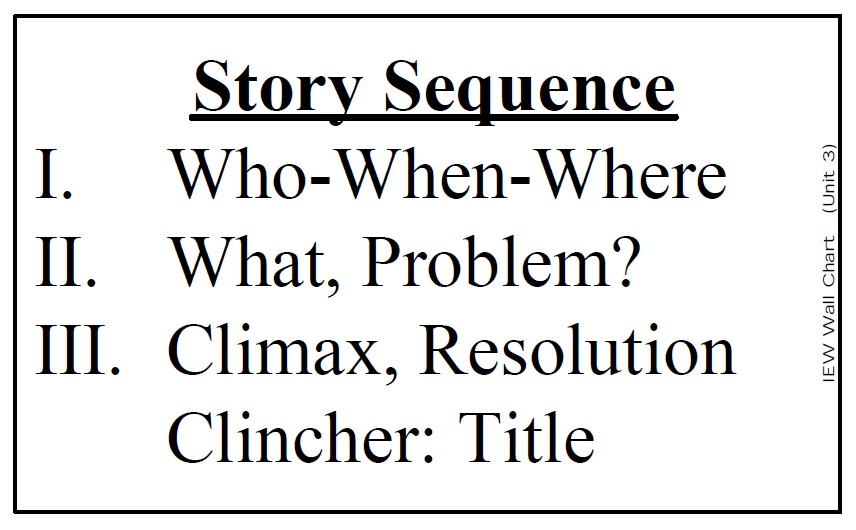
IEW Story Sequence Chart

Now, in Lesson Eight, we move into the first big writing assignment, a three paragraph report.  We are provided with a Story Sequence Chart that guides students to outline the sections of the story so they can write their own version.  The IEW manual provides several questions for each section and actually provides the story sequence outline for two different sections to give students help in starting this critical piece of the lesson and the final one introduced in Paddle to the Sea.  

With each book after Paddle to the Sea, IEW added more Dress-ups and more ways for the boys to express themselves in more complex ways.  The other three books that are read as part of this curriculum are:

  • Tree in the Trail
  • Minn of the Mississippi
  • Seabird 

We LOVED this curriculum!!!  I honestly cannot say enough good things about it.  It gets the highest rating on my scale, a 5 star!  I highly recommend Excellence in Writing period!  They have a yahoo group for questions you may have and the moderators usually answer the questions that day (if not within a few hours)!  They also have a yahoo group for used curriculum.  They do not penalize you or make it difficult for you to purchase their products used.  I can tell you though, they have an unconditional, no time limit, FULL GUARANTEE on their products.  If you teach it and don’t like it, you can return for a full refund! (NOTE that only applies if you buy it directly from them).  They stand behind their products!  

Oh, did I mention that this curriculum was such a huge hit in my house that it has inspired my 13 year old son to write a book (unprompted by mom)!  Yep,  I’m sold, it receives 5 Stars from this happy homeschool Momma for sure!


IEW Geography 5 stars


A couple of final thoughts about when I purchased this curriculum:

  • I WISH I had not been so intimidated by this curriculum and would have just purchased it earlier!  There is so much value in this curriculum that my boys could have been using earlier!  
  • I started with Geography instead of purchasing their core and foundational product Teaching Writing: Structure and Style (TWSS).  I really wanted to get to know the product before I invested a significant amount of money in it.  Once I purchased Geography, it clearly stated in the instructions that TWSS was a pre-requisite, but I still didn’t listen.  By lesson eight, I was regretting not having TWSS and so I bought it then.  I had to reference that curriculum multiple times and watched several parts of the DVDs.  I used it as a resource through out this year’s Geography curriculum, but TWSS is what I am teaching for the first half of 2013 – 2014 and Student Writing Intensive Group A (SWI-A) for the second half of 2013-2014.  

If you have any questions, feel free to ask!  

Until Next Time…. 


If you like this post, please share it!

  • Share on Facebook (Opens in new window) Facebook
  • Share on Pinterest (Opens in new window) Pinterest
  • Share on X (Opens in new window) X
  • Print (Opens in new window) Print
  • More
  • Email a link to a friend (Opens in new window) Email
  • Share on Reddit (Opens in new window) Reddit
  • Share on LinkedIn (Opens in new window) LinkedIn
  • Share on Tumblr (Opens in new window) Tumblr

Like this:

Like Loading…

Kids on Location

April 30, 2013 By: Trish Corlewcomment

Kids on Location

I’ve been brainstorming ideas for our homeschool on what we can do to keep the momentum going through the summer.  And I’ve come up with some ideas my children were ecstatic about!  I want to share these ideas with you and hope that not only will you like the ideas, but that you and your children will participate too!!  So here goes… We have created a page on our blog called “Kids On Location”.  We are going to create a Thursday linky party for posts about the children going on location, like a news broadcaster when they are reporting live on location.  

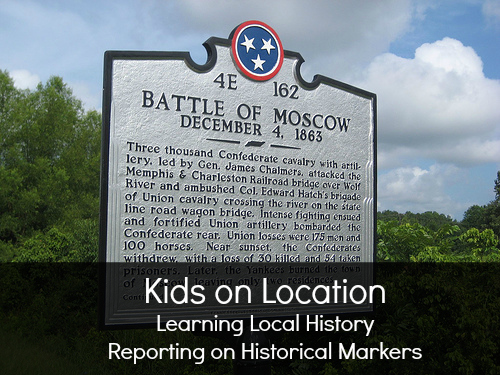
Historical MarkersThe First Idea:  Learning about our local history via Historical Markers.  I don’t know about y’all, but I’m a transplant to this area and I don’t know much about our own local history.  Every couple of weeks, the boys and I will identify our closest historical markers and we will spend an afternoon driving to these markers. You can find your neighborhood historical markers at this national database.  Thank you Jimmie Lanley for posting this link on your Google plus Account, it really got me brainstorming, as you see 🙂   The boys will photograph the markers and the item the marker is describing (if applicable).  They will note the location, the roads (and closest cross roads), the closest towns, the GPS coordinates, etc.  Then each child will pick one historic marker to research and write a news report on for the week. Here is a Historic Marker Form with Prompts  to help our budding reporters develop ideas on how to report on the markers.  Your children might even decide they want to return to the location and give their news report about the Historic Marker via video!  I know some children would love being in front of the camera and others would love to be behind the camera. 

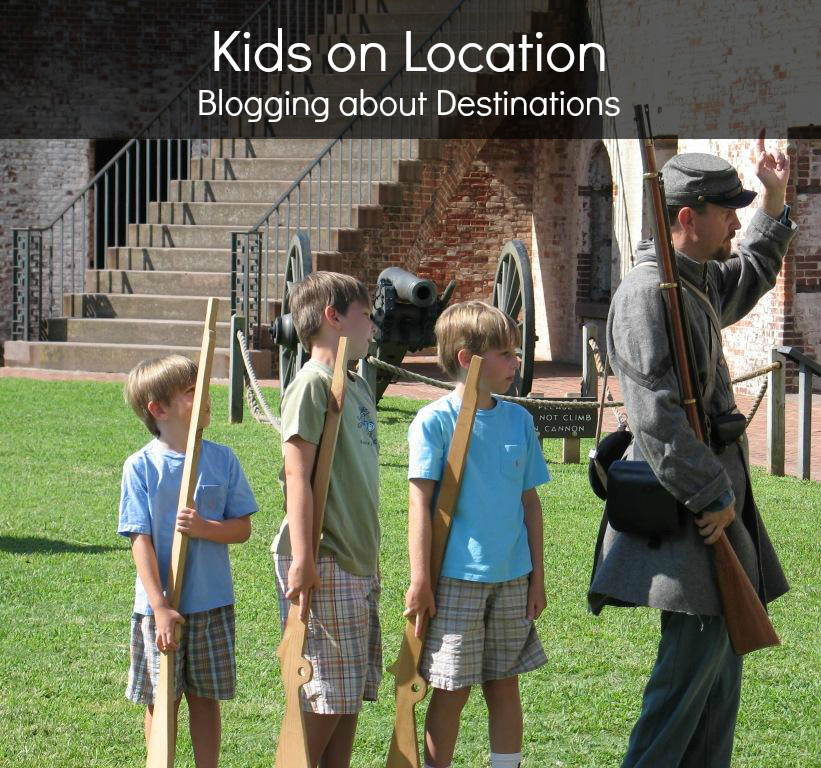
Kids on LocationThe Second Idea:  When we go on field trips, family outings and vacations this summer, have our children report about these destinations. Here is a Kids on Location form that will provide some prompts to help get them started.   And just like before, the children might enjoy doing a recording of them “on location”.  I think this would certainly be considered public speaking training … don’t you?  


Okay, so here is the most unusual aspect of this whole idea:

Teen BloggersLet’s give our children “guest blogger” status on our blogs for the summer and let them do the reporting on this project!  They will upload their own reports to Kids on Location (via the Thursday linky).  You will still have complete control over the publication because guest bloggers’ articles must be approved before they are published.  I am already doing this with my eleven year old son.  Gage has started blogging about his chicken business, Deluxe Clucks.  I cannot even begin to tell you all the positives I’m seeing.  He is WRITING!!!  Hallelujah!  Not only is he writing but he loves it and he loves blogging!  Now, think about it… even if your child only creates one report a week, that is the equivalent of one research project … but without having to pull teeth, without any arguing AND it’s continues the momentum through the summer!  There are so many other positive aspects I’m seeing that I could share but, just imagine for a second….  Your child excited and motivated about writing!  My boys have been doing the IEW / Beautiful Feet Geography Curriculum and writing about Holling Clancy Holling’s books and they have been loving it. But this is really the next level.  Our children imitate us and they certainly see us blogging… so this would give them some real world experience and isn’t that what our homeschools are to be… training for the “real world”?   I think this entire project could really inspire our children and they would have fun at the same time!  If my children were any indication, I think your children will be excited to do this!  

Finally, we will feature a few reports each week that you, the readers, choose.  The Linky will have a “like” button for each link and our readers get to decide who will be featured each week by who gets the most likes.  We have created a button for both the linky and the featured reporter… what do you think of them?

Kids on Location Linky Button


Kids on Location Reporter Button


I am really anxious to hear your feedback!  Please share with me your thoughts, concerns, and ideas!  And then tell me you are in!  I’m hoping we can start the linky party maybe the middle of May?  Does that work for everyone?  


If you like this post, please share it!

  • Share on Facebook (Opens in new window) Facebook
  • Share on Pinterest (Opens in new window) Pinterest
  • Share on X (Opens in new window) X
  • Print (Opens in new window) Print
  • More
  • Email a link to a friend (Opens in new window) Email
  • Share on Reddit (Opens in new window) Reddit
  • Share on LinkedIn (Opens in new window) LinkedIn
  • Share on Tumblr (Opens in new window) Tumblr

Like this:

Like Loading…

God’s Crossroad

April 28, 2013 By: Trish Corlew6 Comments

God's Crossroad, Our ChoiceCrossroads.  My entire life I have never had a difficult time making a decision.  I was never really afraid of making the wrong decision, realizing I could always adjust direction mid-stream.  But here I sit… having hit a major crossroad in my life and not being able to make a decision (yet).  As I ponder why this crossroad is so different than the rest I realize there are many variables making THIS one different, but one primary difference.

God.  First and foremost is God.  

He has transformed me, my goals, my desires, my wants, my focus, my everything!  And this is the first big crossroad I’ve hit since I’m living my life for Him!  I can confidently state that THIS crossroad is one God has brought me to.  I am being pruned, things in my life culled, old habits swept away that are keeping me from Him.  This transformation is why all the other variables have become so important.  Without this transformation, I would be completely focused on me. What works best for MY goals, MY career, MY life, MY desires.  But, it’s not about me… at least, not anymore!  And thus making a decision without “me” being the center of the equation is completely unfamiliar territory.  

Decisions:  Weigh Pros and ConsSecond, I have three boys that trust me and hubby to make smart decisions for them, for their lives, for their future, for their well-being.  I have always relied on myself, to be able to research out a decision and to weigh the pros and cons and make an informed decision and move forward not looking back.  I am pretty shocked at how completely unprepared and entirely inadequate I feel to make this big decision for our children, to take the risk when it will directly impact them.  I was so very comfortable taking risks when it was just me and hubby.  Completely and utterly comfortable.  But God calls us to walk in faith and trust Him.  See, another area He is really working on!

Third, since my life has been transformed, I now want to be a wife. Homeschool Mom.  Family CEO.  Gardener.  Nurse.  Cook.  Chauffeur.  Tour Guide. Party Planner.  Hostess with the Mostest.  I want to mentor and guide my children in becoming well-rounded human beings reliant on our Creator.  I want to introduce them to the world He made and be there to enjoy it with them; to inspire them to learn for the sake of learning and to experience those things that might shape their future.  To be a lighthouse… as God has called us to be!  To be a guide and to encourage them in life’s storms, especially now that they are all entering puberty, one by one.  I don’t want to hire somebody to do that for me.  How many moms do we know that are chasing the corporate dream and are being robbed of these beautiful, precious moments (and they don’t even know it).  I was one of them, I know oh too well!    Abba is taking me down a very different path than I was on!

We are a Messianic family so we keep the Biblical feasts.  Every feast has a profound impact on me, every single one, including the weekly feast of the Sabbath.  But one that has me in awe of our amazing Father and the provision He provided for the Israelites, is Sukkot, often known in the Christian church as Booths.  We call it the “camping feast” at our home because it is when we retell the story of the Exodus and camp out and live like the Israelites did in a Succah (a booth).  One of the things we discuss with the boys over those campfire meals  is what if we were called out in an Exodus the way the Israelites were?  Would we be able to carry our cherished items on our backs?  How about a wagon, could we pull them in a wagon?  How about an SUV, could we fit them all in our SUV?  How about a cattle trailer, would they fit in it?  How about an 18 wheeler, would that be sufficient?  We quickly realize we have a love affair with our material possessions and we have way too much stuff!   We are apparently having trouble prioritizing what is important and what isn’t.  This exercise on Sukkot reminds us we have to prioritize and decide what is important.  

Let God be the GuideTHAT is where we are now.  We are still working through making this decision as a family.  But I know, if we keep God as our personal Guidance System, our GPS if you will, we WILL make the right decision.  He doesn’t change and will finish what He started in us.  We know He will put us where He wants us to serve His purpose!  

Until next time…


This week we are connecting with Thriving Thursday Link Up Party.  Please be sure to visit the host and the other bloggers… there are some great posts!  Be sure to check out A Lamp Full: Service, I especially loved that one!


If you like this post, please share it!

  • Share on Facebook (Opens in new window) Facebook
  • Share on Pinterest (Opens in new window) Pinterest
  • Share on X (Opens in new window) X
  • Print (Opens in new window) Print
  • More
  • Email a link to a friend (Opens in new window) Email
  • Share on Reddit (Opens in new window) Reddit
  • Share on LinkedIn (Opens in new window) LinkedIn
  • Share on Tumblr (Opens in new window) Tumblr

Like this:

Like Loading…

Crazy Weather is Getting Crazier!

April 23, 2013 By: Trish Corlew5 Comments

We have been in full swing for about a month now in the garden.  We are switching from traditional gardening techniques to permaculture gardening and have been in planting mode.  All the cold weather crops were planted weeks ago.  We have been planting early spring crops for a couple weeks.  Just got horseradish in the ground and have so much more to do!  The fruit trees, blueberries and strawberries are in full bloom. The apple trees are blooming at the same time for the very first time since we planted them four years ago.  So this is the first season we even had any hope of getting an apple.  

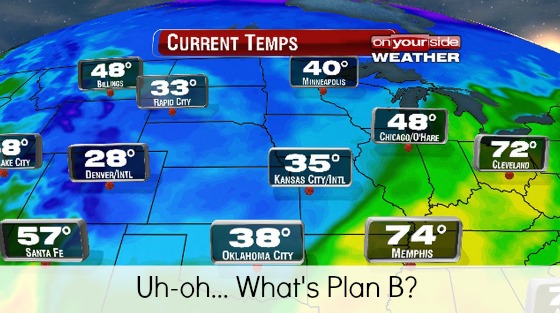
You are feeling pretty good about the progress you are making and the items that are getting knocked off your garden to do list and then you see this on your Facebook page from your local weather man.  I posted it with this comment:  “YOU HAVE GOT TO BE KIDDING ME!”  This crazy weather is getting crazier!


Temps are falling again in Late April!


The usual “Plan B” is to cover your crops and wait it out.  But that is not feasible  with fruit trees in a backyard garden environment.  Situations like this just makes me realize that no matter how planned and prepared we think we are, think again!  

I have always thought that Joseph’s Biblical example was to be our example… be prepared.  You remember, 7 years of plenty with putting back for the seven lean years?  But I have since come to realize that the blessings, the miracles, full protection and full supplication happened in the wilderness!  When they were completely reliant on God for every aspect of their very existence!  

Men will disappoint us, the weather will surprise us, but God doesn’t change.  It is in the wilderness where we will be provided for.  If you are unfamiliar with the provision He provided in the wilderness, pull out your Bibles and reread Exodus.  

Well, I’m off to go figure out how to cover what I can!  Until next time!  


If you like this post, please share it!

  • Share on Facebook (Opens in new window) Facebook
  • Share on Pinterest (Opens in new window) Pinterest
  • Share on X (Opens in new window) X
  • Print (Opens in new window) Print
  • More
  • Email a link to a friend (Opens in new window) Email
  • Share on Reddit (Opens in new window) Reddit
  • Share on LinkedIn (Opens in new window) LinkedIn
  • Share on Tumblr (Opens in new window) Tumblr

Like this:

Like Loading…

Our Concentration is Being Sabotaged by Multitasking!

April 22, 2013 By: Trish Corlew8 Comments

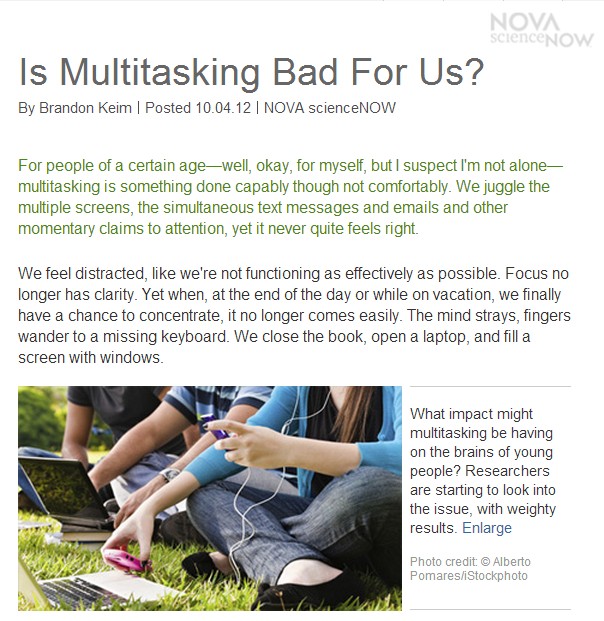
Multitasking is Sabotaging our Ability to ConcentrateI have to admit … I am one of those people who just cannot divvy up my attention well.  I can multitask within a given area, for instance homeschooling pretty well.  But when I try to cross areas, such as farming and homeschooling or homeschooling and cleaning, I seem to constantly be out of balance.  I’m either all one or all the other, I just can’t seem to find the balance!  Well, I read a great article a couple of weeks ago about how our  concentration is being sabotaged by multitasking! It explained so much to me about why I seem to be less organized and less productive these days.  It explained why I completely identify with this quote from the article:

Is Multitasking Bad For Us?


Do two or more things simultaneously, and you’ll do none at full capacity.


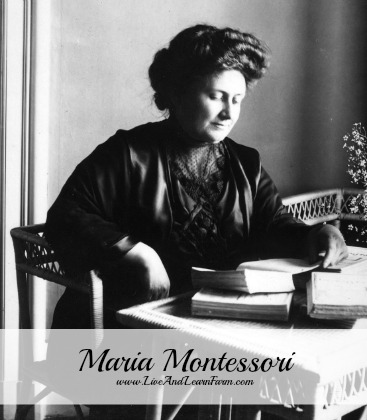
Montessori teachers already know this as fact.  We protect our children’s uninterrupted work period like we are protecting Fort Knox.  Because we realize how important uninterrupted time is to their ability to concentrate!  Why do we, the adults, think we are exempt from this same distraction problem?  Could this be why we are raising a generation of children labeled “ADD? ”  In “The Child, Society and the World”, Maria Montessori stated:  

Maria Montessori“The teacher must recognize the first moment of concentration and must not disturb it. The whole future comes from this moment and so the teacher must be ready for non-interference when it occurs. This is very difficult because the teacher has to interfere at every moment before the children are normalized.”


Montessori saw that concentration was, in fact, the key to the natural development of the child. It became the focus of her subsequent work with teachers.  Montessori trained the teachers to recognize the importance of its occurrence and the degree to which it released the children to work independently and yet in harmony with each other.  She recognized concentration could not be taught or enforced, but that it was, instead, a vital characteristic of human growth and a demonstration that innate mental needs were being satisfied.

As adults we have lost the ability to really concentrate.  Society has imposed on us the idea that the ability to multitask is essential, even vital to success.  With so many companies laying off and employees having to do the work of two or more people, it would seem that multitasking is critical.  But research shows that multitasking is actually leading to less productivity, up to 40% less!   So, I am on a mission to regain the ability to concentrate and really focus on the task at hand.  

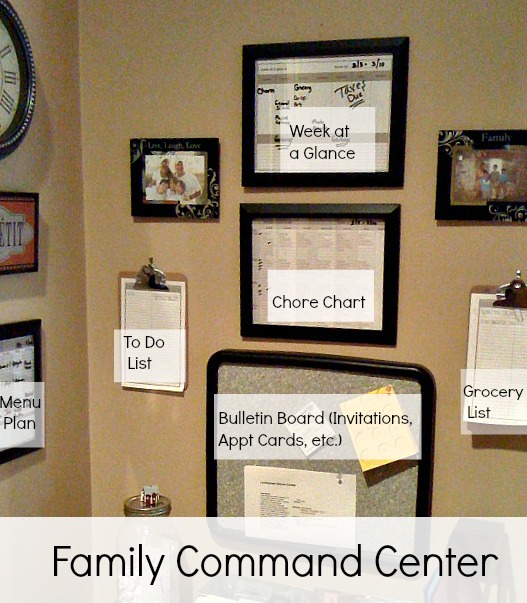
One opportunity I saw in our family was creating organization around our daily tasks.  I created a Family Command Center  so everyone can see at a glance, where others are, what each person needs to get done today and to stay on task.  Those things that must get done daily or weekly that are easily ignored or put off to the last second.  This one area has dramatically helped our organization, and given me more time to concentrate on other things, such as creating new works and helping with the boys’ new businesses.  The command center takes the guess work out of what is happening today, what needs to be done, what’s for dinner, etc.  And, I am pretty good at keeping it up to date and organized.  On the occasions that I have not kept it current, we saw the consequences, one big one seemed to be late meals due to lack of planning.  There are so many beautiful command centers out there.  Search Command Center on Pinterest and you will see how many different ideas there are.  Here is the one I created, using primarily stuff I already had (with a few Dollar Store frames added):


Family Command Center

With my Family Command Center, I put the forms I printed in picture frames and use a white board marker to write on them.  For the weekly menu plan, I also create paper ones, because I create I have a month of meals planned out.  I keep them in our family organization binder.  This keeps me from just repeating the same old recipes, week after week.  I am including the links to the forms below.  I am going to provide them in Word so you can modify them to fit the needs of your own family!  

One thing I do not have on the wall, but am going to create is a daily calendar that is broken up into hours.  I am going to commit to hitting the top priorities for the day FIRST and allocating the time to do so on the calendar, trying to avoid the other nemesis to productivity… Procrastination!  We have already had a family meeting regarding the importance of protecting each other’s times of concentration.  One request that I still need to work on is how do we know when somebody is on the computer if they are working on just surfing.  Does anyone have any ideas?  

Here are the forms I used in our Family Command Center, feel free to use and modify as needed!

Weekly menu plan

Week at a glance blank

Grocery List

Daily to do list blank

Daily chore chart

Until next time….
If you like this post, please share it!

  • Share on Facebook (Opens in new window) Facebook
  • Share on Pinterest (Opens in new window) Pinterest
  • Share on X (Opens in new window) X
  • Print (Opens in new window) Print
  • More
  • Email a link to a friend (Opens in new window) Email
  • Share on Reddit (Opens in new window) Reddit
  • Share on LinkedIn (Opens in new window) LinkedIn
  • Share on Tumblr (Opens in new window) Tumblr

Like this:

Like Loading…
« Previous Page
Next Page »
  • Pinterest
  • Facebook
  • Twitter
  • Google+
  • Sulia

Subscribe to our blog

Email

HHMTeamMember3-01

Winner-Top-Ten-BlogDesign10

Top Posts

  • But I Don't Want to be the Policeman!
    But I Don't Want to be the Policeman!
  • Hands-on Activity for Studying Globes and Maps
    Hands-on Activity for Studying Globes and Maps
  • Start a Home Economics Class in Your Homeschool
    Start a Home Economics Class in Your Homeschool
  • Brimwood Press Worldview Curriculum Review
    Brimwood Press Worldview Curriculum Review
  • nature journal post 2
    nature journal post 2

Affiliates / Sponsors

Give lynda.com

Shop Montessori Services

Newsletter Affiliate

We create and distribute our newsletter via MadMimi! It is SOOO easy to use! I highly recommend it!
Mad Mimi Email Marketing

Grab A Button

LiveAndLearnFarm.com Just select and copy the code below.
<a href="http://www.LiveAndLearnFarm.com" target="_blank"><img src="http://www.LiveAndLearnFarm.com/blog/wp-content/LiveLearnFarmButton.jpg" alt="LiveAndLearnFarm.com" width="125" height="125" /></a>

Copyright © 2026 · Modern Blogger Pro Theme By, Pretty Darn Cute Design

Loading Comments...

    %d